Préparation :
- Préparez d’abord la brioche. Mélangez la farine, la levure, le sucre et le sel dans un grand saladier. Ajoutez les œufs, le lait tiède et une cuillère de fleur d’oranger. Pétrissez jusqu’à obtenir une pâte souple, puis incorporez le beurre mou en petits morceaux.
- Laissez la pâte devenir lisse et élastique. Elle doit se décoller des parois sans devenir sèche. Formez une boule, couvrez et laissez lever jusqu’à ce qu’elle double de volume.
- Façonnez un disque épais sur une plaque recouverte de papier cuisson. Aplatissez légèrement le dessus avec la paume pour garder une forme régulière. Laissez lever encore, puis parsemez de sucre perlé avant cuisson.
- Faites cuire la brioche jusqu’à ce qu’elle soit bien dorée. La croûte doit prendre une belle couleur ambrée, avec un dessus légèrement bombé. Laissez refroidir complètement avant de couper.
- Pendant ce temps, préparez la crème. Chauffez le lait avec la fleur d’oranger. Fouettez les jaunes avec le sucre et la maïzena, puis versez le lait chaud dessus en fouettant.
- Reversez le mélange dans la casserole et faites épaissir jusqu’à obtenir une crème lisse. Hors du feu, ajoutez le beurre, puis laissez tiédir. Incorporez la crème liquide montée pour obtenir une texture légère et onctueuse.
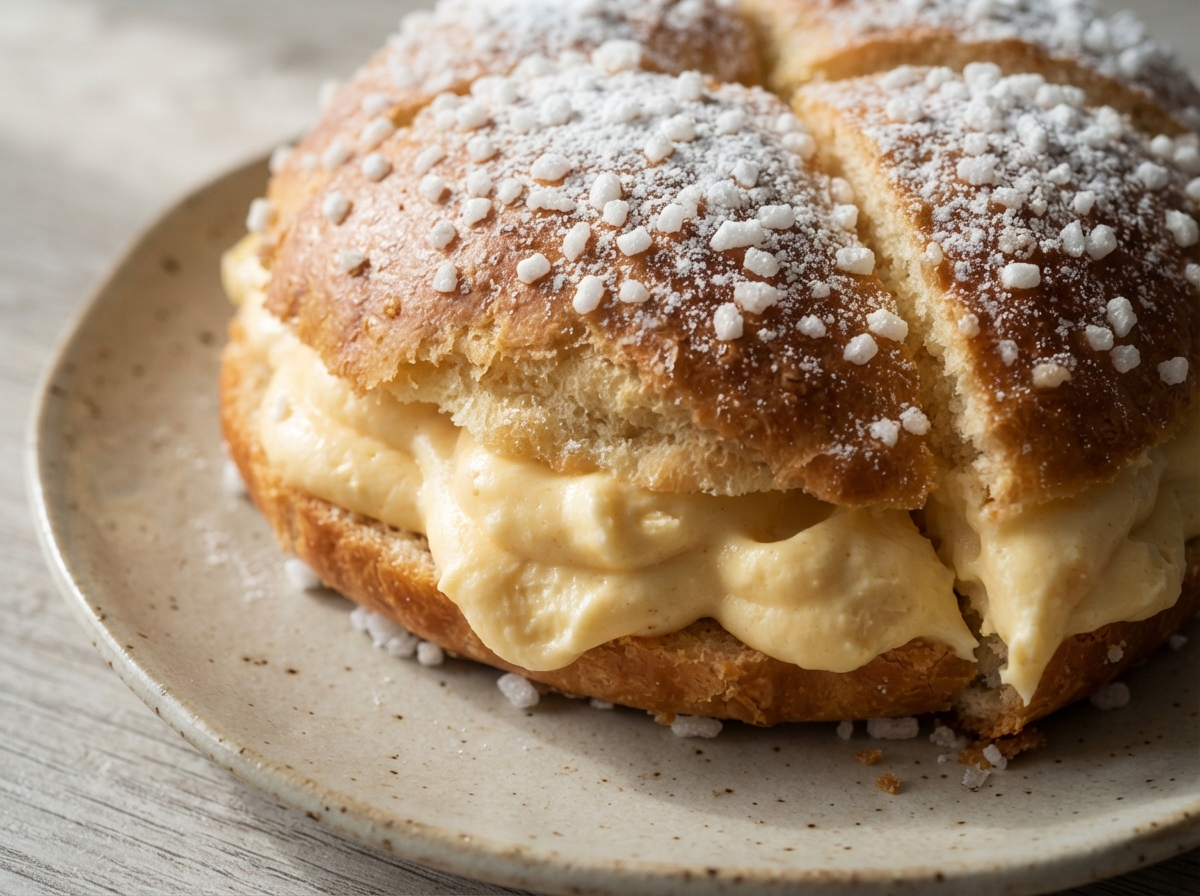
- Coupez la brioche en deux dans l’épaisseur. Garnissez généreusement la base avec la crème, puis refermez avec le chapeau. Réservez au frais pour que la crème se tienne bien.
- Juste avant de servir, saupoudrez légèrement de sucre glace si vous le souhaitez. Servez la tarte tropézienne bien fraîche, avec une crème parfumée et une brioche moelleuse.
- En cuisine, la tarte tropézienne à la fleur d’oranger joue sur un contraste très agréable. La brioche est tendre, la crème est douce, et le parfum floral reste délicat. C’est un dessert généreux, lumineux, et toujours très gourmand.Ce que j’apprécie dans cette recette, c’est son équilibre. Elle demande un peu de temps, mais les gestes restent simples et accessibles. On obtient une brioche moelleuse, une crème légère, et une vraie sensation de pâtisserie maison.Le mariage entre la fleur d’oranger et la crème mousseline fonctionne à merveille. La douceur du sucre perlé apporte du relief, sans alourdir l’ensemble. C’est une pâtisserie française idéale pour un goûter, un brunch, ou un dessert de fête.Vous pouvez ajuster le parfum selon vos envies. Ajoutez un peu plus de fleur d’oranger pour une note plus marquée, ou une touche de vanille pour arrondir la crème. Cette tarte tropézienne se prête très bien à une cuisine maison simple et soignée.Elle plaît autant aux adultes qu’aux enfants. Elle convient très bien pour recevoir, ou pour un dimanche gourmand en famille. Servez-la avec des fruits frais, ou avec un café serré pour compléter le dessert.
- image_prompt
- Final dish presentation:
– photographed from a 30-to-35-degree camera angle above the dish (sweet spot 35°), camera positioned slightly above the rim of the vessel and looking slightly downward. The FOOD SURFACE (garnish, sauce, pieces inside) faces the viewer as the main subject and occupies at least 55-65% of the vessel's visible height. The top rim forms a moderately flattened ellipse with a height-to-width ratio between 1/2.5 and 1/3.5 — NEITHER a very thin ellipse (which would be a near-side 15-25° view, forbidden) NOR a near-round circle (which would be a near-top-down 50-plus-degree view, forbidden). The outer side wall of the vessel is visible but takes no more than 30-40% of the vessel's visible height — a frame around the food surface, not the main subject. Food content shows real depth with front pieces partially hiding back pieces. A soft blurred kitchen background is visible behind the dish.
– **tarte tropézienne à la fleur d’oranger** presented as a fully assembled, finished French pastry on a light oak wooden serving board, never in a baking tin, never in a cake mold, never on a tray insert.
– the whole brioche round is centered in the frame, already cut open horizontally, with one generous wedge-shaped slice area missing from the top to reveal the cream filling inside
– the remaining brioche keeps a natural round shape with a clean horizontal cut face, and the top half sits slightly offset so the cream layer is visible
– the filling is a thick, pale ivory cream mousseline with a light silky sheen, clearly visible between the two brioche layers
– the brioche crust is deeply golden-brown, softly domed, and lightly glossy, with a tender crumb visible on the cut surface
– the surface is lightly scattered with fine sugar pearls baked into the top, showing small amber beads embedded in the crust
– a very light dusting of powdered sugar is optional and subtle, never heavy, never hiding the golden brioche surface
– the pastry should feel plush, airy, and generous, with visible volume and a soft, pillowy structure
– the slice gap is clearly readable, and the cut edge matches the visible interior of the whole pastry exactly
– the whole pastry remains centered and dominant, with only the board and a soft neutral background around it
– no cutlery visible, no fork, no knife, no spoon anywhere in the frame — this pastry is presented as a dessert centerpiece
– no hands, no utensils, no baking tin, no parchment, no countertop clutter, no extra props
– framed as an extreme close-up macro product shot : the dish and its vessel fill nearly the entire frame (at most 3-8% margin on each side), touching the frame edges — no cutlery of any kind visible, no folded napkin beside the vessel, no props of any kind in the frame, no elaborate kitchen ambiance behind — just the dish, its vessel, and the bare surface it rests on cropped by the frame edges. Tight, high-impact, Pinterest-thumbnail composition designed to stop the scroll
– natural daylight, soft side lighting, warm highlights on the brioche crust, gentle shadows, shallow depth of field, realistic bakery-style texture, ultra-realistic professional food photography
– authentic homemade French pastry appearance, slightly irregular natural crust, no industrial smoothness, no artificial shine
– color palette: deep golden-brown brioche crust, pale ivory cream filling, soft beige crumb, tiny amber sugar pearls, clean light wood board
– visual realism: realistic volume, natural crumb structure, no duplicated patterns, no impossible geometry, no overdecorated garnish
– food photography: 85mm macro lens feel, crisp focus on the cut edge and cream layer, strong but natural background blur, magazine-style realism
– no timing text, no descriptions overlay, no extra notes, no clutter, minimal shadows, no numbers, no digits, no badges, no watermark, no logo, no captions of any kind anywhere in the image - collage_prompt
- A vertical Pinterest-style food photography collage for **tarte tropézienne à la fleur d’oranger**, portrait orientation, 2:3 aspect ratio, EXACTLY 6 square photo panels arranged in a 2-column by 3-row grid (2×3, total 6, no more no less), same bowl/pan/plate and consistent lighting across all panels. This is a plain photographic grid, not an infographic, not a tutorial graphic, not a diagram — just six ordinary food photographs placed side by side. ABSOLUTELY NO TEXT ANYWHERE: no panel numbers, no digits, no badges, no circles, no ingredient name captions or labels under bowls or items, no watermark, no words in any language. Pure photography only, zero typography of any kind.
Style:
– ultra-realistic food photography, bright natural lighting, clean modern kitchen aesthetic, soft shadows and realistic textures, elegant Pinterest-style composition, premium food magazine look, soft pastel or white background, FIXED 35-DEGREE CAMERA ANGLE above the food for EVERY one of the 6 panels, highly appetizing and realisticPanneau en haut à gauche — ingredients:
– small separate bowls and plates showing the real ingredients for the recipe: flour, dry baker’s yeast, sugar, salt, eggs, soft butter, orange blossom water, warm milk, whole milk, egg yolks, cornstarch, heavy cream, and pearl sugar
– each ingredient should look fresh and realistic in its own small container, with natural colors and textures
– no labels, no ingredient names, no text under any bowl, only visible ingredientsPanneau en haut à droite — mixing the brioche dough:
– a large bowl with the brioche dough being mixed into a soft, sticky mass, showing flour, eggs, milk, sugar, yeast, and orange blossom water coming together
– the dough should look rough at first but already cohesive, with a warm pale beige tone
– the bowl must be a plain mixing bowl, not a serving dish
– no hands visible, no whisk, no overlay textPanneau du milieu à gauche — kneaded and enriched dough:
– the dough now looks smooth, elastic, and glossy from kneading, with softened butter fully incorporated
– it sits as a neat risen dough ball in a bowl, showing clear stretch and softness
– the panel should feel like the next stage after mixing, with a visibly transformed dough texture
– no utensils, no labels, no extra propsPanneau du milieu à droite — baked brioche round:
– the brioche is fully baked, round, and deeply golden-brown, with a domed top and pearl sugar baked into the crust
– it is placed on a light oak wooden serving board, not in the baking tray, not in a mold
– the crust should show the same deep golden color and tender crumb described in the main image prompt
– the board and lighting must match the final presentation style exactlyPanneau en bas à gauche — the finished pastry whole:
– the complete tarte tropézienne à la fleur d’oranger, fully assembled on the same light oak wooden serving board
– the brioche is shown whole with the cream filling visible from a slight cut or opening, so the dessert looks generous and ready to serve
– the golden crust, pale cream layer, and pearl sugar must all be visible
– no tin, no pan, no parchment, no separate plate, no cutleryPanneau en bas à droite — extreme close-up final slice:
– a very tight macro close-up of a single thick slice of the tarte tropézienne, centered perfectly in frame
– the slice fills almost the entire panel, with only a minimal margin and a soft blur around it
– the cut interior must show the soft brioche crumb and the thick cream filling in sharp detail
– the slice rests stably on the same light oak wooden serving board, with no floating, no hand, no utensils, no extra props
– the camera angle stays consistent with the other panels, but the framing is much tighter, creating a dramatic final appetizing close-upFood details:
– the brioche should always look golden, airy, and bakery-fresh
– the cream must look smooth, pale ivory, and lightly glossy
– pearl sugar should appear as small amber beads baked into the crust
– the texture must remain the same across panels whenever the same element appearsQuality:
– ultra-detailed, professional food photography, aesthetic Pinterest virale, realistic 4K look, clean composition, coherent lighting, cohesive colors across all 6 panels
– the final collage must feel like a professional recipe step-by-step visual for a French pastry blogSTRICT REQUIREMENTS: portrait orientation, 2:3 aspect ratio, exactly 6 panels total, arranged in a 2×3 grid, absolutely no more and no less. ABSOLUTELY NO TEXT ANYWHERE IN THE IMAGE, of any kind: no panel numbers, no digits, no step counters, no numbered badges or circles, no ingredient names written as captions or labels under bowls/items, no watermark, no logo, no captions, no words in any language, no typography of any kind. This is a pure photograph — if you find yourself about to render any letter, word, or number anywhere in the frame, do not. Pure photography only, zero graphic overlays, zero text.
Conseils :
- Utilisez des œufs et du lait tièdes pour aider la levure à lever plus régulièrement.
- Laissez la brioche refroidir complètement avant de la couper, sinon la crème glisse et détrempe la mie.
- Montez la crème liquide bien froide pour obtenir une garniture légère et stable.
- Ajoutez la fleur d’oranger en deux fois si vous voulez un parfum plus équilibré.
- Gardez la tropézienne au frais au moins deux heures avant le service pour une coupe nette.
FAQs :
Peut-on préparer la tarte tropézienne à la fleur d’oranger la veille ?
Oui, c’est même une bonne idée. Préparez la brioche et la crème à l’avance, puis assemblez le tout quelques heures avant de servir.
Comment conserver une tarte tropézienne briochée après montage ?
Gardez-la au réfrigérateur, dans une boîte bien fermée. Elle se conserve mieux pendant 24 heures, avec une brioche encore agréable.
Peut-on remplacer la fleur d’oranger dans cette recette de dessert français ?
Oui, vous pouvez la remplacer par de la vanille ou un peu de zeste d’orange. Le goût sera différent, mais la crème restera délicate.
La crème mousseline peut-elle être remplacée par une autre crème ?
Vous pouvez utiliser une crème pâtissière plus simple, mais la texture sera moins aérienne. La crème mousseline apporte le fondant typique de la tropézienne.
Cette tarte tropézienne convient-elle à un régime sans gluten ?
Non, la brioche contient de la farine de blé. Pour une version sans gluten, il faudrait revoir toute la base, ce qui change la texture.
Peut-on servir cette brioche avec crème mousseline froide ou à température ambiante ?
Servez-la bien fraîche pour une tenue parfaite. Sortez-la dix minutes avant dégustation pour retrouver plus de moelleux.