Préparation :
- Émincez les échalotes et l’ail. Nettoyez les champignons, puis coupez-les en quartiers ou en lamelles selon leur taille. Coupez le sauté de porc en gros morceaux réguliers pour une cuisson homogène.
- Faites chauffer l’huile d’olive et le beurre dans une cocotte. Saisissez le porc sur toutes ses faces jusqu’à obtenir une belle coloration dorée. Ajoutez les échalotes et l’ail, puis laissez-les devenir translucides et légèrement parfumés.
- Ajoutez les champignons dans la cocotte. Faites-les revenir jusqu’à ce qu’ils rendent leur eau et commencent à colorer. Saupoudrez la farine, mélangez bien, puis versez le madère en grattant le fond pour décoller les sucs.
- Ajoutez le bouillon de volaille. Mélangez, puis portez à frémissement. Couvrez et laissez mijoter à feu doux jusqu’à ce que la viande soit tendre et la sauce réduite, souple et bien liée.
- Incorporez la crème fraîche épaisse en fin de cuisson. Rectifiez l’assaisonnement avec le sel et le poivre, puis laissez encore quelques minutes pour obtenir une sauce lisse et nappante.
- Ajoutez le persil plat juste avant de servir. Servez le sauté de porc bien chaud, avec une sauce brillante et des champignons fondants.
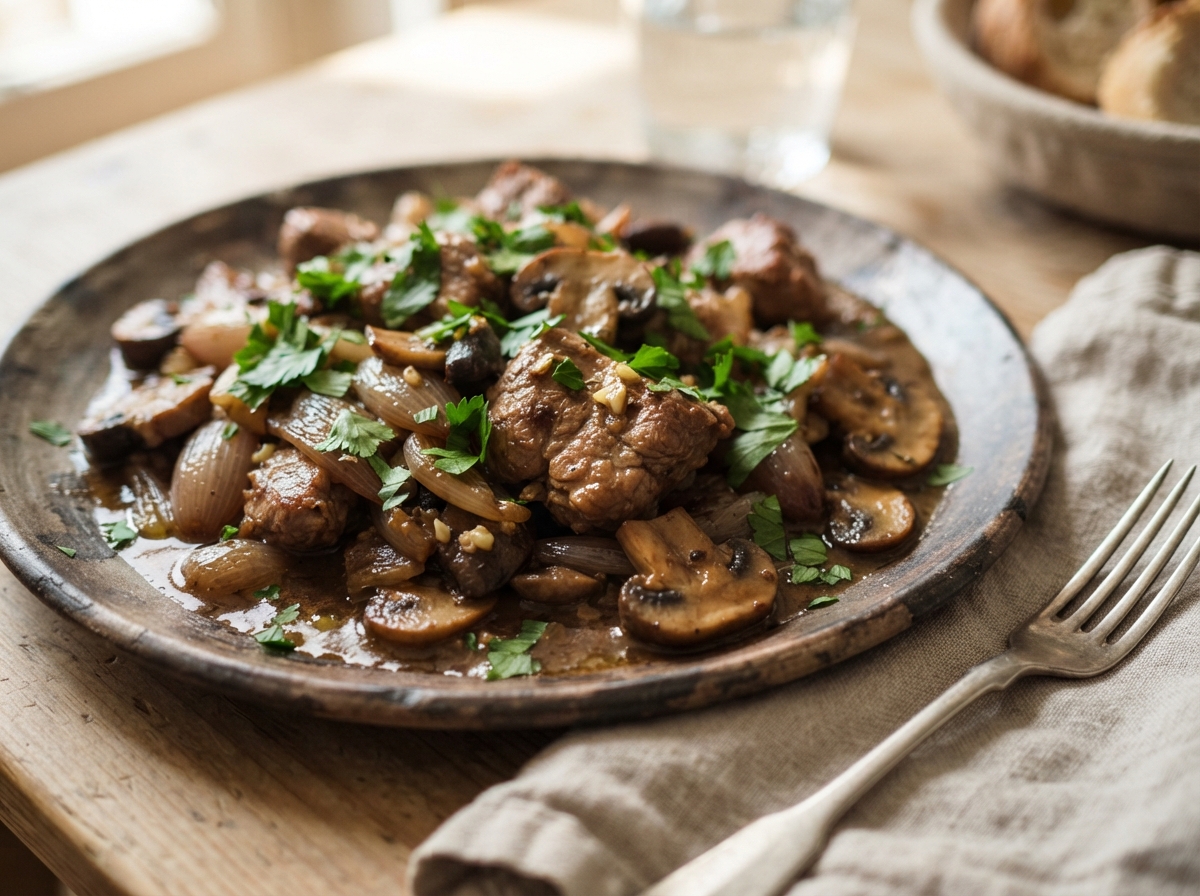
- En cuisine, un plat mijoté rassure toujours. Le sauté de porc mijoté aux champignons et sauce au madère apporte ce plaisir simple et généreux. La viande devient tendre, la sauce se concentre, et l’assiette gagne tout de suite en caractère.Ce que j’apprécie dans ce sauté de porc, c’est son côté direct et sans complication. La préparation reste accessible, même pour un repas de semaine. En moins de deux heures, on obtient une viande fondante et une sauce au madère très parfumée.Le mariage entre les champignons et le madère fonctionne à merveille. On retrouve une sauce ronde, légèrement boisée, avec une belle profondeur en bouche. Le tout reste équilibré par la crème fraîche, qui adoucit la cuisson sans masquer les saveurs.Vous pouvez adapter cette base très facilement. Un peu de thym, une feuille de laurier ou quelques grains de moutarde apportent une nuance différente. Pour une version plus légère, servez ce plat avec du riz complet ou du quinoa.C’est une recette qui plaît autant aux adultes qu’aux enfants. Elle trouve sa place dans un déjeuner du dimanche comme dans un dîner de semaine. Ajoutez simplement des crudités, des pommes de terre vapeur ou une purée maison pour compléter le repas.
- image_prompt
- **Sauté de porc mijoté aux champignons et sauce au madère**, served hot and fully finished in an opaque matte cream ceramic serving bowl with solid, fully opaque walls — the contents are visible only from the top opening, never through the sides of the bowl.
Final dish presentation:
– photographed from EXACTLY a 35-degree camera angle above the dish (fixed camera elevation for every image produced, never 15°, never 25°, never 40°, never top-down, never front-on)
– the bowl is centered horizontally in the frame
– extreme close-up macro product shot, the dish and its vessel fill nearly the entire frame, with only a small breathing margin around the edges
– no cutlery visible, no fork, no knife, no spoon anywhere in the frame
– no extra props, no elaborate kitchen scene, only the bowl and the bare surface beneath it
– the dish sits on a light oak wooden surface, with a minimal blurred neutral background
– the serving bowl remains fully visible and centered, with the rim intact inside the frame
– the hero ingredient is the pork and it must dominate visually, occupying approximately 55% of the visible composition
– the pork is cut into generous tender chunks, coated in glossy brown sauce, surrounded by mushrooms
– the sauce looks velvety, glossy, and naturally reduced, never thin or watery
– the mushrooms are clearly visible as browned slices and quartered pieces, evenly distributed through the sauce
– the persil plat appears as a delicate fresh green finishing herb, finely scattered on top
– the dish must look authentic, homemade, French, and warmly rustic
– no invented garnish, no extra herbs, no lemon, no parsley mound, no decorative additions not described in the recipe
– the contents are visible only from the top opening, never through the sides of the bowl
– framed as an extreme close-up macro product shot : the dish and its vessel fill nearly the entire frame (at most 3-8% margin on each side), touching the frame edges — no cutlery of any kind visible, no folded napkin beside the vessel, no props of any kind in the frame, no elaborate kitchen ambiance behind — just the dish, its vessel, and the bare surface it rests on cropped by the frame edges. Tight, high-impact, Pinterest-thumbnail composition designed to stop the scrollSauté de porc texture:
– tender, juicy pork chunks with lightly browned edges
– the meat looks moist and fibrous, never dry or shredded
– coated in a glossy brown sauce that clings to the surfaceChampignons texture:
– browned, soft mushroom quarters and slices
– slightly glossy from the sauce, with visible curved caps and softened edges
– distinct pieces, never mashed or melted into the sauceSauce au madère texture:
– deep brown, velvety, glossy sauce
– smooth and lightly thickened, with a rich sheen
– pooled gently around the meat and mushrooms without looking greasyÉchalotes texture:
– softened translucent pieces, finely cut
– pale golden and partially melted into the sauce
– discreet but still visible in the background of the braiseAil texture:
– tiny softened golden fragments
– integrated into the sauce, never burnt
– subtle and glossy, barely visible but presentBeurre texture:
– fully melted into the base of the sauce
– adds a soft sheen and rounded richness
– not visible as separate solid piecesHuile d'olive texture:
– only a light glossy undertone in the sauce base
– invisible as a separate layer
– contributes a faint sheen on the surfaceMadère texture:
– deep amber-brown cooking liquid reduced into the sauce
– glossy, aromatic, and concentrated
– never foamy or dilutedBouillon de volaille texture:
– integrated into the sauce, giving it body and moisture
– not visible as broth, but as the soft braising base
– supports the velvety consistencyCrème fraîche épaisse texture:
– pale creamy body blended into the sauce
– smooth, thick, and lustrous
– softens the darker madère tone without erasing itFarine texture:
– completely dissolved and invisible as a thickening agent
– creates a smooth, cohesive sauce
– no dry flour dusting remains visiblePersil plat texture:
– finely chopped fresh green flecks
– delicate and scattered lightly over the finished dish
– bright, fresh, and not clumpedSel, poivre texture:
– invisible seasoning, but implied by the finished balance
– no visible crystals or grains should dominate the surface
– the final dish should look properly seasoned, not salted on topColor palette:
– deep brown sauce
– golden-brown pork
– beige and ivory mushroom tones
– soft pale green herb flecks
– warm caramel highlightsVisual realism:
– authentic homemade French stew appearance, natural sauce reduction, realistic mushroom distribution, no duplicated ingredient patterns, visible ingredient separation, realistic volume and depthFood photography:
– ultra-realistic professional food photography, soft diffuse natural window-side lighting highlighting glossy and wet textures with gentle shadows for volume, shallow depth of field, strong background blur, 85mm macro lens feel, highly detailed textures, 8K photorealistic quality, razor-sharp focus on the food, culinary magazine styleNo timing text, no descriptions overlay, no extra notes, no clutter, minimal shadows, no numbers, no digits, no numbered badges or circles, no watermark, no logo, no captions of any kind anywhere in the image.
- collage_prompt
- A vertical Pinterest-style food photography collage for **Sauté de porc mijoté aux champignons et sauce au madère**, portrait orientation, 2:3 aspect ratio, EXACTLY 6 square photo panels arranged in a 2-column by 3-row grid (2×3, total 6, no more no less), same bowl and consistent lighting across all panels. This is a plain photographic grid, not an infographic, not a tutorial graphic, not a diagram — just six ordinary food photographs placed side by side. ABSOLUTELY NO TEXT ANYWHERE: no panel numbers, no digits, no badges, no circles, no ingredient name captions or labels under any bowl or item, no watermark, no words in any language. Pure photography only, zero typography of any kind.
Style:
– ultra-realistic food photography, bright natural lighting, clean modern kitchen aesthetic, soft shadows and realistic textures, elegant Pinterest-style composition, premium food magazine look, soft pastel or white background, FIXED 35-DEGREE CAMERA ANGLE above the food for EVERY one of the 6 panels, identical camera elevation across all 6 panels, highly appetizing and realistic
– consistent opaque matte cream ceramic serving bowl in the finished panels, same surface beneath the bowl in the finished panels
– keep the visual identity faithful to a French homemade braise: browned pork, softened mushrooms, glossy madère sauce, no exotic props, no Asian accessoriesPanneau en haut à gauche — ingrédients:
– raw diced or chunked pork sauté pieces in a small bowl, pale pink with light marbling, fresh and moist
– whole or halved Paris mushrooms in a small bowl, beige-white caps with clean stems
– peeled shallots in a small bowl, pale purple and glossy
– peeled garlic cloves in a small bowl, ivory and smooth
– butter in a small dish, pale yellow and solid
– olive oil in a tiny glass or ceramic dish, clear golden-green sheen
– madère in a small glass or bowl, deep amber-brown liquid
– chicken stock in a small bowl, pale golden broth
– crème fraîche épaisse in a small bowl, thick off-white and glossy
– flour in a small bowl, fine matte white powder
– flat parsley leaves in a small bowl, fresh bright green
– salt and pepper in tiny separate or combined pinch bowls, understated and realisticPanneau en haut à droite — sautéing the pork:
– a hot opaque cocotte or deep pan on the stove, with pork chunks browning in butter and olive oil
– the pork pieces should show golden-brown searing on several sides, with visible browned fond at the bottom
– shallots and garlic begin to soften around the meat, slightly translucent and glossy
– steam rises gently, and the pan surface looks active and hot
– this panel must show a real cooking vessel in use, not a chopping board, not raw ingredient mise en placePanneau du milieu à gauche — mushrooms and deglazing:
– the browned pork now joined by mushrooms added into the same opaque cocotte
– mushrooms look softened and slightly reduced, some browned edges visible
– flour is absorbed into the surface of the meat and vegetables, no raw flour dust remaining
– madère being deglazed into the pan as a deep amber-brown glossy liquid that loosens the browned bits
– the sauce starts to gather at the bottom, still relatively thin but clearly forming
– this panel should look visually different from the first cooking panel, with wetter deglazing and more sauce visiblePanneau du milieu à droite — simmering and sauce reduction:
– the cocotte now contains pork and mushrooms in a simmering sauce enriched with chicken stock
– the sauce has thickened into a darker glossy brown, visibly reduced and coating the meat more fully
– gentle bubbling is visible at the edges, with steam suggesting slow braising
– the mushrooms look tender and integrated, the pork pieces appear more supple and coated
– this panel must clearly represent a later cooking stage than the previous one, with a richer and thicker saucePanneau en bas à gauche — plat fini en entier:
– the finished sauté de porc is served in the same opaque matte cream ceramic serving bowl as the featured image
– the bowl is filled generously, centered, and shown as a complete finished dish
– pork chunks are tender, browned, and coated in glossy brown sauce
– mushrooms are visibly distributed throughout, soft and appetizing
– the parsley is lightly scattered over the top as a fresh green finish
– the surface of the sauce looks smooth, velvety, and rich
– no extra garnish beyond parsley, no invented decoration, no lemon, no cream swirl, no additional herbsPanneau en bas à droite — extreme close-up final serving detail:
– a single richly coated pork chunk with mushrooms and sauce, resting in the same opaque matte cream ceramic serving bowl
– tight macro framing, very close, with the glossy sauce and browned edges dominating the frame
– the pork should look tender and juicy, the mushroom pieces soft and clearly visible
– the parsley appears as tiny green flecks on the sauce, subtle and fresh
– the composition is centered, stable, and immersive, with the bowl surface visible only as needed to anchor the serving
– bright natural light, creamy highlights, strong appetizing texture, no spoon, no fork, no hand, no lifted bite, no action gesture
– the bowl and surface must match the finished panel, so this feels like a closer crop from the same serving sceneDifferentiation between panels:
– each of the 6 panels must show a clearly different visual stage
– avoid repeating the same framing or the same amount of sauce in adjacent panels
– the three action panels must progress logically from searing to deglazing to simmering
– the finished panels must show the same vessel and surface as the featured image
– keep all details realistic, homemade, and visually coherentFood details:
– pork should never look raw in the cooking panels after searing has begun
– mushrooms should look freshly cooked, never rubbery or blackened
– the sauce should remain glossy and brown, never pale or curdled
– parsley should appear fresh and finely chopped, never wilted
– proportions should be realistic and appetizingQuality:
– ultra-detailed professional food photography, clean composition, vibrant natural tones, consistent lighting across all 6 panels, realistic reflections and steam, 4K realism, polished Pinterest-ready presentationSTRICT REQUIREMENTS: portrait orientation, 2:3 aspect ratio, exactly 6 panels total, arranged in a 2×3 grid, absolutely no more and no less. ABSOLUTELY NO TEXT ANYWHERE IN THE IMAGE, of any kind: no panel numbers, no digits, no step counters, no numbered badges or circles, no ingredient names written as captions or labels under bowls/items, no watermark, no logo, no captions, no words in any language, no typography of any kind. This is a pure photograph — if you find yourself about to render any letter, word, or number anywhere in the frame, do not. Pure photography only, zero graphic overlays, zero text.
Conseils :
- Coupez le porc en gros morceaux réguliers pour obtenir une cuisson homogène et une viande bien moelleuse.
- Faites bien dorer la viande avant d’ajouter les liquides pour renforcer le goût de la sauce au madère.
- Laissez les champignons rendre leur eau à feu vif avant le mijotage pour éviter une sauce détrempée.
- Ajoutez la crème fraîche hors du feu vif pour garder une sauce lisse et bien nappante.
- Servez ce porc mijoté avec du riz, des pommes de terre vapeur ou une purée maison pour un repas complet.
- Préparez le plat la veille si possible, car les saveurs se développent encore mieux après repos.
FAQs :
Peut-on préparer ce sauté de porc à l’avance ?
Oui, ce plat se prépare très bien la veille. Réchauffez-le doucement à feu doux, avec un peu de bouillon si la sauce a trop épaissi.
Peut-on remplacer le madère dans cette sauce au madère ?
Oui, vous pouvez utiliser du porto, du vin blanc sec ou un peu de cognac dilué avec du bouillon. Le goût sera différent, mais la sauce restera riche et agréable.
Cette recette de porc mijoté est-elle sans gluten ?
Pas en l’état, à cause de la farine. Vous pouvez la remplacer par de la fécule de maïs, ajoutée diluée dans un peu de bouillon.
Comment adapter ce plat familial sans lactose ?
Remplacez la crème fraîche par une crème végétale cuisine, bien stable à la cuisson. Choisissez une version neutre pour ne pas masquer le goût du madère.
Comment conserver le sauté de porc aux champignons ?
Conservez-le trois jours au réfrigérateur dans un récipient fermé. Réchauffez-le doucement, car une chauffe trop forte peut durcir la viande.
Peut-on servir ce sauté de porc froid ?
Ce plat est meilleur chaud, car la sauce au madère révèle alors toute sa rondeur. Froid, la texture devient plus dense et la viande paraît moins fondante.