Préparation :
- Faites revenir l’oignon finement haché dans le beurre, à feu moyen, jusqu’à transparence. Ajoutez l’ail écrasé, puis le veau haché. Émiettez bien la viande avec une spatule pour obtenir une farce régulière.
- Ajoutez les épinards dans la poêle par petites poignées. Laissez-les tomber complètement, puis faites évaporer l’excès d’eau. La préparation doit rester souple, mais pas humide.
- Hors du feu, incorporez la crème fraîche, la moutarde douce et une pincée de noix de muscade. Salez, poivrez, puis mélangez jusqu’à obtenir une farce homogène et liée. Laissez tiédir quelques minutes.
- Déroulez la pâte feuilletée sur une plaque ou un plan de travail légèrement fariné. Répartissez la farce au centre, en laissant des bords libres tout autour. Repliez la pâte, soudez soigneusement, puis badigeonnez la surface avec l’œuf battu.
- Pratiquez quelques petites incisions sur le dessus pour laisser la vapeur s’échapper. Enfournez jusqu’à ce que le feuilleté soit bien gonflé et bien doré. La pâte doit être croustillante et la farce chaude au cœur.
- Laissez reposer quelques minutes avant de couper. Servez le feuilleté de veau aux épinards bien chaud, avec une salade verte ou des légumes croquants.
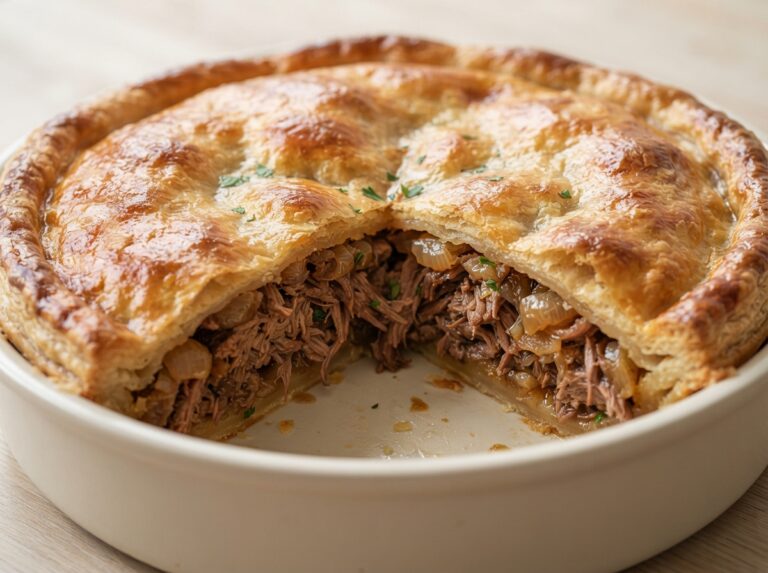
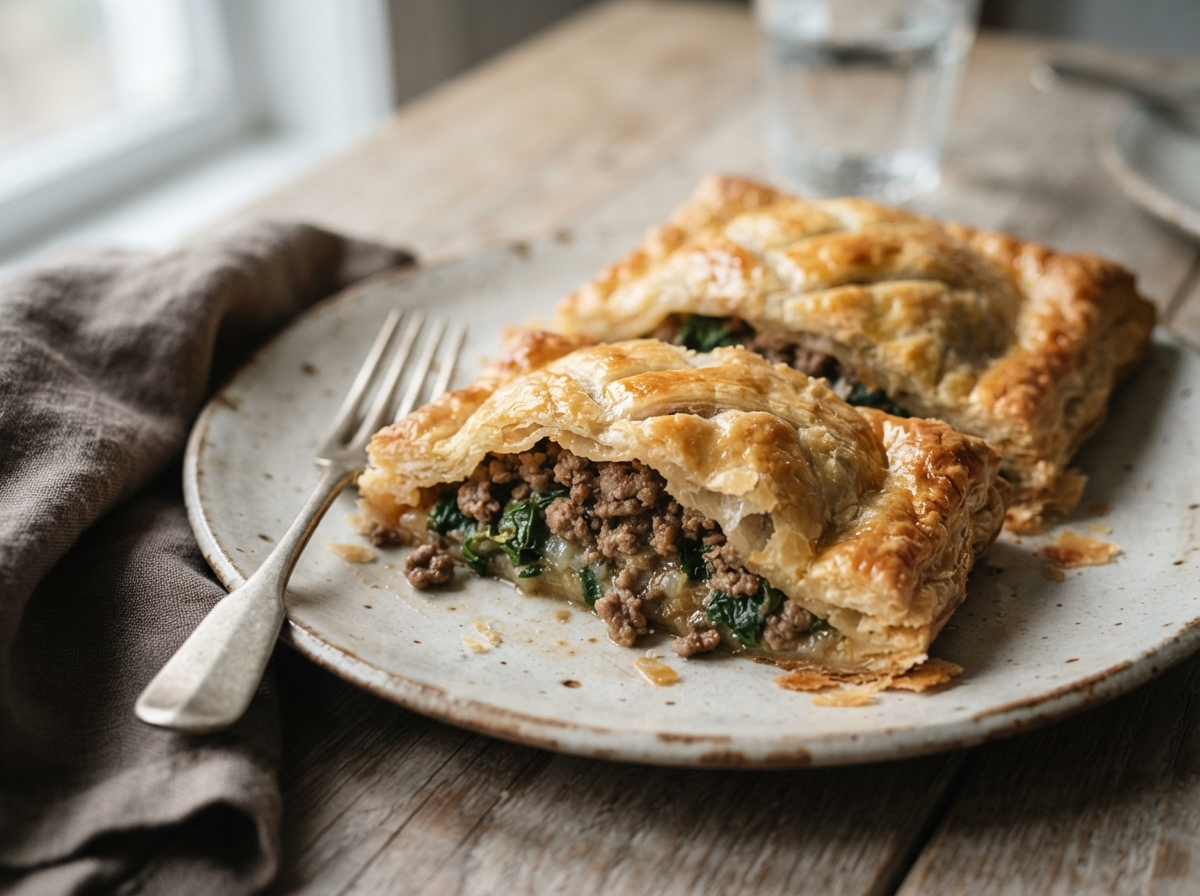
- En cuisine, le feuilleté de veau aux épinards apporte un vrai équilibre. La pâte dorée protège une garniture tendre et moelleuse. Le contraste est immédiat, net, et très plaisant en bouche.Ce que j’apprécie surtout, c’est sa simplicité d’exécution. Le feuilleté de veau se prépare en moins d’une heure. Il donne pourtant l’impression d’un plat travaillé et généreux.Le mariage entre le veau, les épinards et la crème fraîche est très doux. La moutarde ajoute juste ce qu’il faut de relief. La noix de muscade souligne l’ensemble sans prendre le dessus.On peut facilement adapter cette base selon la saison. Quelques herbes, un peu de fromage râpé ou des graines sur la pâte changent le caractère du plat. Cette recette reste idéale pour une cuisine rapide et équilibrée.Ce feuilleté plaît autant aux adultes qu’aux enfants. Il convient très bien pour un dîner familial ou pour recevoir sans stress. Servez-le avec une salade verte, du quinoa ou des crudités croquantes pour compléter l’assiette.
- image_prompt
- **Feuilleté de veau aux épinards** served as a finished, golden, baked savory puff pastry parcel, sliced open to reveal the tender filling, styled as a single realistic plated dish ready to eat.Final dish presentation:
– photographed from EXACTLY a 35-degree camera angle above the dish (fixed camera elevation for every image produced, never 15°, never 25°, never 40°, never top-down, never front-on)
– the dish is served on an opaque matte cream ceramic serving plate with solid, fully opaque walls and a visible rim, never a transparent container
– the plate is centered horizontally in the frame, with the whole plated dish filling nearly the entire image, extreme close-up macro product shot, only a minimal neutral background visible
– no cutlery visible, no fork, no knife, no spoon anywhere in the frame
– no extra props, no elaborate kitchen ambiance, just the plate and the bare surface it rests on
– the feuilleté is shown already cut open with one large section revealed, so the cross-section is visible and the pastry is not presented as a closed intact parcel
– the puff pastry shell is deeply golden, flaky, layered, lightly blistered, with crisp lifted edges and a homemade French bakery look
– the filling is a cohesive savory mixture of pale cooked veal, wilted dark-green spinach, soft onion, and a creamy pale sauce, visibly moist but not runny
– the interior should feel tender and comforting, with a clear contrast between crisp pastry and soft filling
– the cut face must look natural and realistic, with a visible clean slice through the pastry and the filling packed inside
– the dish remains centered and dominant, occupying about 80-90% of the frame width
– background surface is a light oak wooden table or pale neutral surface, blurred heavily, with no busy décor
– no timing text, no overlay, no watermark, no logo, no captions, no badges, no numbers, no digits
– authentic homemade French savory pastry appearance, warm golden tones, slight irregularities in the pastry from baking, natural filling texture, realistic steam-free finished serving state
– the hero element is the puff pastry parcel, which must visually dominate the composition while still clearly revealing the veal and spinach filling inside
– the cut section should be the visual focus, with the filling visible in the foreground and the crisp layers of pastry framing it
– the pastry exterior must remain visibly flaky and layered, never smooth or bread-like, never glossy like a pie crust
– the spinach must appear as softened dark-green leaves folded into the filling, not raw and not pureed
– the veal must appear as small, tender, cooked pieces or finely shredded chunks, pale beige to light golden, embedded in the creamy filling
– the creamy binder should look velvety, slightly glossy, pale ivory, coating the filling evenly without flooding the plateFeuilleté de veau aux épinards texture:
– deeply golden-brown flaky puff pastry with crisp, layered, delicately blistered sheets
– slight sheen from baking, with uneven natural browning on the top and edges
– the cut edge shows distinct pastry layers, not a smooth crustVeal texture:
– tender pale beige cooked pieces, moist and compact
– small irregular chunks or shreds visible in the cut face, never raw, never drySpinach texture:
– dark green wilted leaves, soft and folded
– visible as tender strands and leaf fragments inside the filling, not wateryOnion texture:
– softened pale golden onion pieces, translucent and gently melted into the filling
– fine and integrated, not crunchy or brownedCream fraîche texture:
– velvety, glossy, pale ivory binder coating the filling
– smooth and rich, lightly clinging to the meat and spinachPâte feuilletée texture:
– crisp, airy, layered sheets with visible lift between the folds
– brittle edges and golden lamination clearly visibleEgg wash texture:
– subtle baked gloss on the surface, golden and slightly shiny
– natural uneven shine on raised pastry ridgesMoutarde douce texture:
– barely visible inside the filling, creamy and blended
– soft pale yellow tint in the inner mixture, never harsh or separatedBeurre texture:
– baked-in richness in the pastry and filling, not visible as separate pieces
– contributes to the golden, glossy surface and soft mouthfeelNoix de muscade texture:
– very fine, invisible seasoning with a warm hint in the filling
– not visible as pieces, only suggested through the creamy mixtureSel texture:
– fully dissolved seasoning, invisible in the finished dish
– supports flavor without any visible crystalsPoivre texture:
– tiny specks lightly distributed in the filling, subtle and sparse
– no heavy black speckling, just a restrained seasoning lookColor palette:
– deep golden pastry, pale ivory cream, soft beige veal, dark green spinach, light golden onion, warm buttery highlightsVisual realism:
– authentic homemade French savory pastry, natural flaky layers, realistic baked browning, no duplicated patterns, visible ingredient separation in the cut cross-section, realistic volume and depthFood photography:
– ultra-realistic professional food photography, soft diffuse natural window side-lighting highlighting crisp pastry and creamy filling, gentle shadows for volume, shallow depth of field, strong background blur, 85mm macro lens feel, highly detailed textures, 8K photorealistic quality, razor-sharp focus on the cut face and pastry layers, culinary magazine styleNo timing text, no descriptions overlay, no extra notes, no clutter, minimal shadows, no numbers, no digits, no watermark, no logo, no captions of any kind anywhere in the image.
- collage_prompt
- A vertical Pinterest-style food photography collage for **Feuilleté de veau aux épinards**, portrait orientation, 2:3 aspect ratio, EXACTLY 6 square photo panels arranged in a 2-column by 3-row grid (2×3, total 6, no more no less), same serving plate and consistent lighting across all panels. This is a plain photographic grid, not an infographic, not a tutorial graphic, not a diagram — just six ordinary food photographs placed side by side. ABSOLUTELY NO TEXT ANYWHERE: no panel numbers, no digits, no badges, no circles, no ingredient name captions or labels under any bowl or item, no watermark, no words in any language. Pure photography only, zero typography of any kind.Style:
– ultra-realistic food photography, bright natural lighting, clean modern kitchen aesthetic, soft shadows and realistic textures, elegant Pinterest-style composition, premium food magazine look, soft neutral background, FIXED 35-DEGREE CAMERA ANGLE above the food for EVERY one of the 6 panels, identical camera elevation across all 6 panels, never top-down, never flat lay, never a three-quarter overhead view, never a low eye-level view, exactly 35 degrees above the food for consistent framing, highly appetizing and realisticPanneau en haut à gauche — ingredients:
– raw veal mince in a small matte bowl, pale pink-beige and finely textured
– fresh spinach leaves in a second small bowl, deep green and slightly crinkled
– one whole onion, pale golden skin, placed beside a small peeled onion piece
– two garlic cloves, ivory and smooth
– thick cream in a small ramekin, pale ivory and glossy
– one whole sheet of puff pastry laid flat, pale beige and lightly dusted with flour
– one egg in a small bowl, yolk vivid yellow and white translucent
– a small pat of butter on a dish, pale yellow and solid
– a small spoonful of mild mustard in a tiny bowl, soft yellow and creamy
– a pinch of nutmeg in a tiny dish, warm brown powder
– a small pinch of salt and a little black pepper in separate tiny pilesPanneau en haut à droite — cooking the aromatics and veal:
– a warm skillet with chopped onion turning translucent in melted butter
– minced garlic just added, softening gently
– veal mince breaking apart in the pan, pale beige at first with light browning starting at the edges
– the mixture looks moist and actively sautéing, with light steam and a realistic sheen from the butter
– no finished plating yet, just the first cooking stage inside the panPanneau du milieu à gauche — spinach and creamy filling stage:
– spinach leaves added to the skillet and collapsing into dark green wilted strands
– the veal mixture now combined with thick cream and mild mustard, turning into a cohesive pale creamy filling
– the texture is smooth and glossy, with visible spinach ribbons and small cooked veal pieces embedded throughout
– the pan still shows the cooking process clearly, with the filling thickening and becoming homogeneousPanneau du milieu à droite — assembly and baked finish:
– the puff pastry sheet spread on a work surface or baking tray, with the creamy veal and spinach filling placed in the center as a compact mound
– the pastry folded over the filling to form a sealed parcel, brushed with egg wash, before baking or just after baking with a rich golden crust
– if shown after baking, the pastry is deeply golden, puffed, and blistered, with crisp laminated edges
– the filling must not be messy or leaking heavily; it should look neatly enclosed and ready to servePanneau en bas à gauche — the whole finished dish:
– the finished feuilleté de veau aux épinards displayed whole on a matte cream ceramic serving plate, not in a baking tray, not in a pan, not on a baking sheet
– the pastry parcel is golden, puffed, and beautifully baked, with subtle cracks and crisp layers
– one generous cut is already made so the cross-section is visible, showing the creamy veal and spinach filling inside
– the plate is centered, the dish fills most of the frame, and the surface underneath is a light oak wooden table or pale neutral surface, heavily blurred
– no cutlery visible, no fork, no knife, no spoon anywhere in the framePanneau en bas à droite — extreme close-up final portion:
– a single thick slice or serving piece of the feuilleté, resting stably on the same cream ceramic plate or a small visible section of the same serving plate, centered dead middle in the frame
– the portion fills almost the entire frame, with only a small margin around it, showing crisp flaky pastry layers and the creamy veal-spinach filling in sharp detail
– the cut interior is the main focus, with rich golden pastry at the edges and the creamy green-flecked filling clearly visible
– the piece must look physically stable and logically resting on the plate, never floating, never tilted impossibly
– bright natural light, clean pale background, very strong bokeh blur, no dark moody shadows
– same angle as the other panels, just much tighter framingDifferentiation visuelle obligatoire entre les 6 panneaux:
– each panel must show a clearly distinct stage, never two panels that look almost identical
– top left is ingredients only
– top right is early sautéing in the pan
– middle left is the creamy spinach-veal filling stage
– middle right is assembly or baked sealed parcel stage
– bottom left is the whole finished plated dish with one clean cut revealing the inside
– bottom right is the tight macro close-up of a single serving pieceFood details:
– the veal should look tender, pale beige, and finely cooked, never raw-looking
– the spinach should look wilted and dark green, never fresh and stiff
– the cream should look thick, velvety, and lightly glossy
– the puff pastry should look flaky, layered, and deeply golden after baking
– the filling should remain cohesive and realistic, with visible ingredient separation only where appropriateQuality:
– ultra-detailed, professional food photography, elegant Pinterest viral aesthetic, realistic textures, consistent lighting, premium 4K look, clean composition, clear culinary storytellingSTRICT REQUIREMENTS: portrait orientation, 2:3 aspect ratio, exactly 6 panels total, arranged in a 2×3 grid, absolutely no more and no less. ABSOLUTELY NO TEXT ANYWHERE IN THE IMAGE, of any kind: no panel numbers, no digits, no step counters, no numbered badges or circles, no ingredient names written as captions or labels under bowls/items, no watermark, no logo, no captions, no words in any language, no typography of any kind. This is a pure photograph — if you find yourself about to render any letter, word, or number anywhere in the frame, do not. Pure photography only, zero graphic overlays, zero text.
Conseils :
- Faites bien évaporer l’eau des épinards pour éviter une pâte détrempée après cuisson.
- Laissez la farce tiédir avant de garnir la pâte feuilletée pour garder un feuilletage bien croustillant.
- Soudez les bords avec un peu d’œuf battu, puis retournez la jointure dessous si possible.
- Incisez légèrement le dessus avant d’enfourner pour laisser la vapeur s’échapper sans fendre la pâte.
- Servez ce feuilleté de veau avec une salade verte bien assaisonnée ou des légumes croquants.
- Ajoutez un peu de fromage râpé dans la farce pour une version plus fondante et plus gourmande.
FAQs :
Peut-on préparer ce feuilleté de veau à l’avance ?
Oui, vous pouvez préparer la farce quelques heures avant. Laissez-la refroidir, puis garnissez la pâte au dernier moment pour garder un feuilletage bien croustillant.
Comment conserver le feuilleté de veau aux épinards ?
Conservez-le au réfrigérateur dans une boîte hermétique pendant deux jours maximum. Réchauffez-le au four pour retrouver une pâte plus croustillante.
Peut-on remplacer la crème fraîche dans cette recette au four ?
Oui, vous pouvez utiliser de la crème légère ou une alternative végétale épaisse. Évitez les versions trop liquides, car elles ramollissent la pâte feuilletée.
Cette recette de cuisine française convient-elle sans gluten ?
Pas avec une pâte feuilletée classique, car elle contient généralement du gluten. Choisissez une pâte feuilletée sans gluten du commerce pour adapter la recette.
Peut-on servir ce plat familial chaud ou froid ?
Il est meilleur chaud, juste après un court temps de repos. Froid, il reste bon, mais la pâte perd une partie de son croustillant.
Quelles variations peut-on essayer avec les épinards et la pâte feuilletée ?
Vous pouvez ajouter un peu de fromage râpé, de thym ou de persil haché. Une touche de champignons poêlés fonctionne aussi très bien.