Préparation :
- Épluchez le céleri-rave, puis coupez-le en fines rondelles régulières. Le plus simple est de garder une épaisseur proche de trois millimètres. Faites aussi préchauffer le four pour obtenir une cuisson homogène et une surface bien dorée.
- Frottez un plat à gratin avec la gousse d'ail coupée, puis beurrez généreusement le fond et les bords. Cette base parfumée évite que le céleri accroche et donne un goût plus rond au résultat final.
- Disposez une première couche de céleri-rave dans le plat. Salez légèrement, poivrez, puis ajoutez un peu de noix de muscade et de parmesan. Recommencez jusqu’à épuisement des rondelles, en tassant légèrement pour former un gratin régulier.
- Mélangez la crème fraîche avec le lait, puis versez ce mélange sur les légumes. Le liquide doit arriver entre les couches et non les noyer complètement. Terminez avec le reste de parmesan et la chapelure pour créer une croûte plus croustillante.
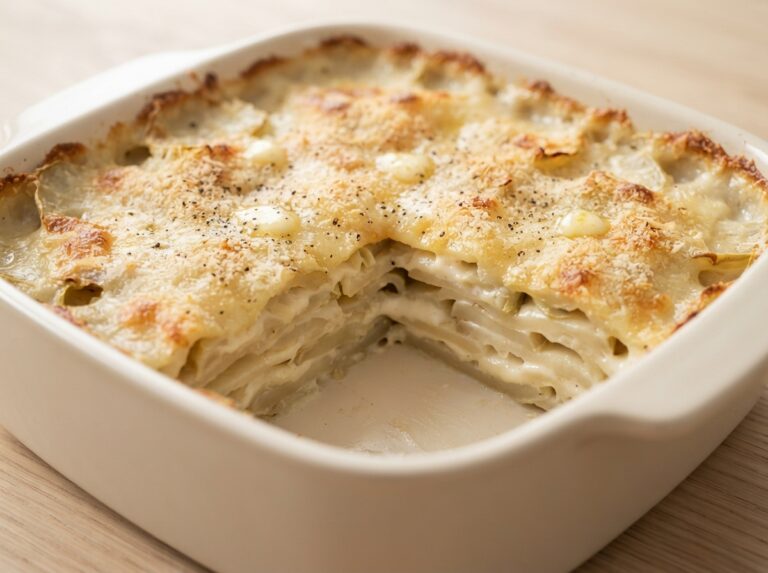
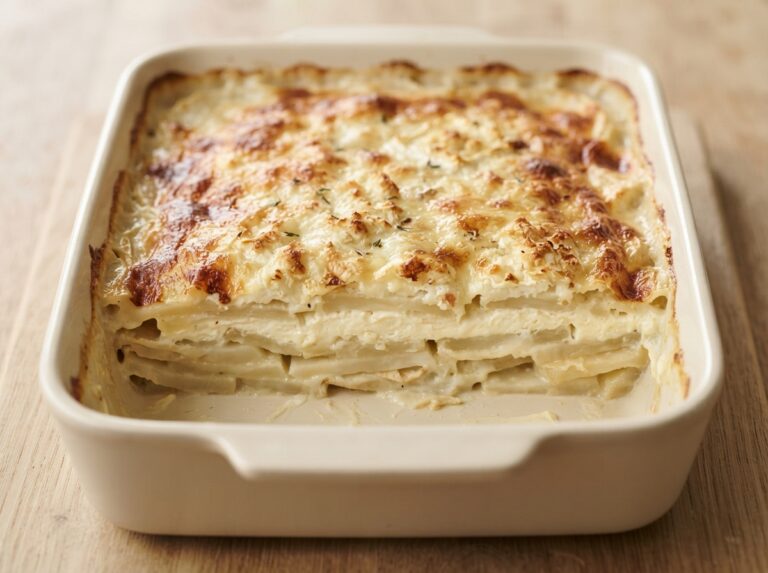
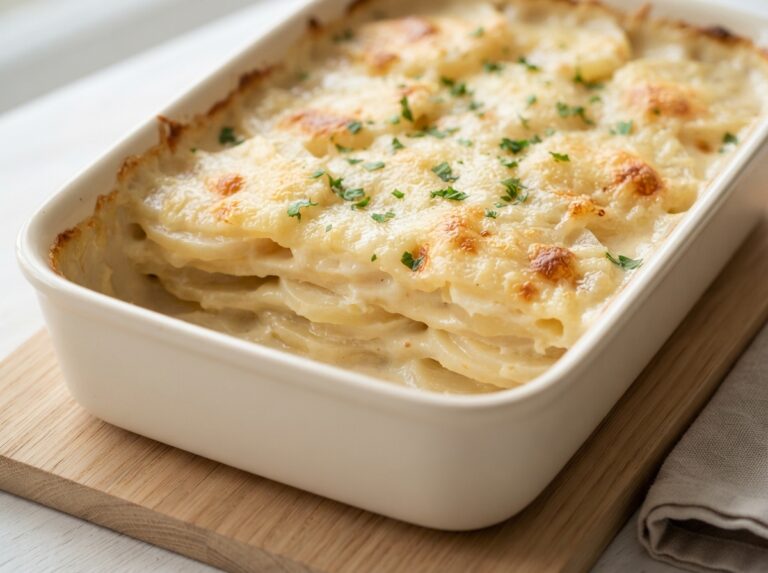
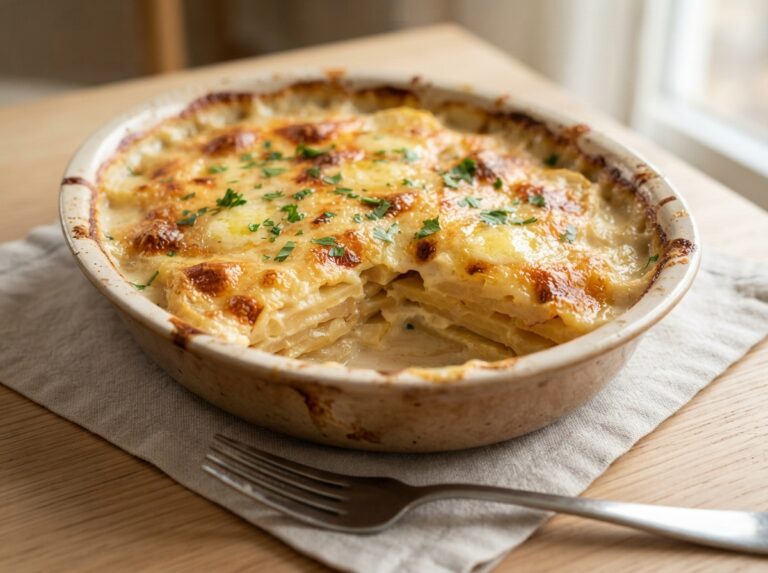
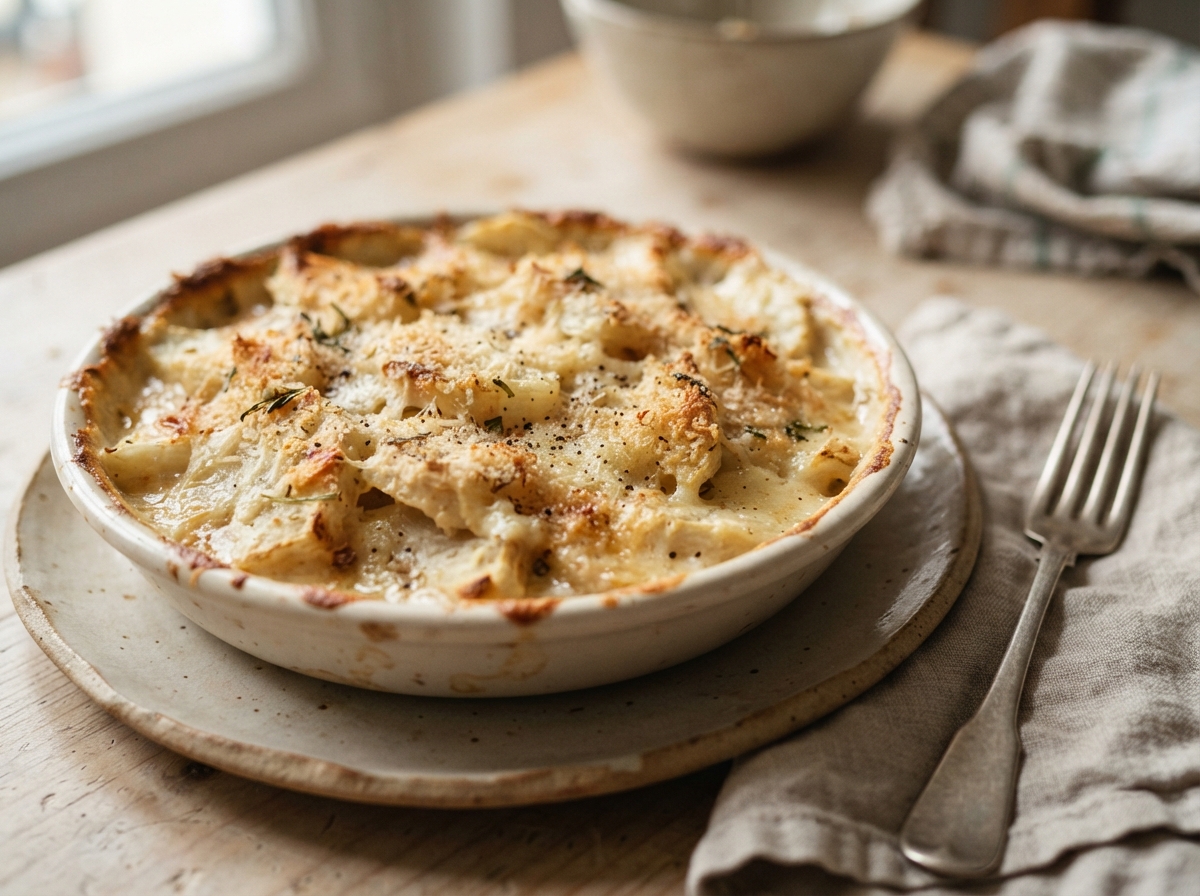
- Enfournez le plat jusqu’à ce que le dessus soit bien doré et que le céleri soit tendre sous la pointe d’un couteau. La surface doit présenter des zones gratinées, avec quelques bords plus foncés et appétissants. Laissez reposer quelques minutes avant de servir.
- Servez le gratin bien chaud, directement dans son plat de cuisson. La coupe doit rester nette et montrer des couches de céleri-rave fondantes, liées par la crème et le parmesan.
- En cuisine, le gratin de céleri-rave au parmesan apporte tout de suite du réconfort. Il est simple, généreux et très parfumé. Le céleri-rave devient doux à la cuisson. Le parmesan lui donne une touche salée et dorée qui change tout.Ce que j’apprécie dans ce gratin céleri-rave, c’est sa simplicité. La préparation demande peu de gestes actifs. En moins de vingt minutes, le plat est prêt à passer au four. Ensuite, la cuisson fait presque tout le travail.J’aime aussi son équilibre entre douceur et caractère. Le céleri-rave devient fondant, tandis que le parmesan apporte une vraie profondeur. La crème lie l’ensemble sans alourdir la bouche. On obtient un plat d’hiver très agréable, parfait en accompagnement ou en plat léger.La recette se personnalise facilement. Vous pouvez ajouter du thym, de la sauge ou un peu de paprika doux. Une poignée de noisettes concassées apporte aussi du croquant. Pour une version plus légère, remplacez une partie de la crème par du lait. Ce gratin de céleri-rave reste pratique pour une cuisine rapide et équilibrée.Il plaît souvent à toute la table, même aux enfants curieux. Il convient aussi bien au repas du quotidien qu’à un dîner avec des invités. Servez-le avec une salade verte, du quinoa ou un riz complet. Vous pouvez aussi l’associer à un rôti, un poisson au four ou des légumes rôtis.
- image_prompt
- **Gratin de céleri-rave au parmesan**, fully baked, golden, bubbling, and served hot in its final presentation.
Final dish presentation:
– photographed from EXACTLY a 35-degree camera angle above the dish (fixed camera elevation for every image produced, never 15°, never 25°, never 40°, never top-down, never front-on)
– the entire opaque matte ceramic baking dish is centered horizontally in the frame and fills nearly the whole image
– extreme close-up macro product shot, with only a minimal neutral background visible
– served directly in a solid, fully opaque ceramic gratin dish, never visible through the sides
– no cutlery visible, no fork, no knife, no spoon anywhere in the frame
– no extra props, no elaborate kitchen ambiance, no visible cooking tools
– the whole gratin is centered in the frame with one clean corner section removed and out of frame, leaving a neat empty gap that reveals the cross-section of the filling on both cut sides and at the back of the gap — no extracted portion is visible anywhere in the image, only the whole dish with the empty slot
– the cut face shows 3 to 4 clearly alternating layers of thin celery-rave slices and creamy parmesan binding, stacked on top of each other, each layer distinctly visible as a separate stratum, not blended into one mass
– the top finishing layer is a golden parmesan crust, lightly crisped and uneven in the most appetizing way, with tiny toasted crumbs and a few deeper brown spots
– the hero ingredient, celery-rave, must dominate visually and occupy most of the visible cut section
– framed as an extreme close-up macro product shot: the dish and its vessel fill nearly the entire frame, touching the frame edges, with at most 3-8% margin on each side
– the dish rests on a light oak wooden serving board or a neutral stone surface, but the board remains mostly cropped by the frame
– soft diffuse natural window light from the side, gentle shadows, shallow depth of field, strong background blur, realistic homemade French cooking appearance
– authentic baked texture, slightly irregular surface, golden-brown crust, creamy interior, visible moisture at the cut edge, no artificial perfectionGratin layers:
– top layer: a golden parmesan crust, pale amber to deep golden-brown, lightly crisp and toasted, with small irregular browned patches
– middle layers: alternating thin slices of celery-rave, pale ivory with a faint beige tint, coated in a smooth creamy sauce, visible as distinct strata
– binding layer: glossy cream mixed with parmesan, soft off-white and velvety, clinging between the slices without hiding them
– base layer: the same celery-rave slices continue to the bottom, with a slightly more moist and tender look near the dishSTRICT INGREDIENT CONSISTENCY:
– the celery-rave must appear as thin round slices, tender and stacked, never as cubes or mashed puree
– the cream must appear smooth, velvety, and lightly glossy, never watery or separated
– the parmesan must appear grated and melted into the surface, with toasted crumbs on top
– the garlic must be subtle and integrated, never visible as large chunks
– the butter must only contribute a rich, glossy baked edge, never as a visible melted pool
– the milk must be absorbed into the creamy binder, never shown as a separate liquid layer
– the nutmeg must be implied by seasoning, not visible as a separate garnish
– the salt must be invisible, only affecting taste and seasoning
– the pepper must appear as tiny dark specks within the cream and on the surface
– the breadcrumb topping must look like fine pale-golden crumbs, lightly crisped
– never substitute ingredients, no ingredients outside the recipeSTRICT QUANTITY CONSISTENCY:
– quantity must clearly correspond to 1 celery-rave as the hero ingredient
– quantity must clearly correspond to 100 g of parmesan across the top and within the layers
– quantity must clearly correspond to 20 cl of cream and 10 cl of milk as a generous creamy binder
– quantity must clearly correspond to 30 g of butter used for the dish preparation
– the celery-rave is the hero ingredient and must occupy approximately 65% of the visible dish
– never reduce ingredient quantities for aesthetic reasonsColor palette:
– pale ivory celery-rave slices
– creamy off-white sauce
– golden parmesan crust
– warm beige baked edges
– tiny dark pepper specksVisual realism:
– authentic homemade French gratin appearance, natural browning, visible steam-like warmth, realistic melted cheese behavior, no duplicated slice patterns, believable volume and depthFood photography:
– ultra-realistic professional food photography, soft diffuse natural window/side-lighting highlighting glossy and creamy textures with gentle shadows for volume, shallow depth of field, strong background blur, 85mm macro lens feel, highly detailed textures, 8K photorealistic quality, razor-sharp focus on the food, culinary magazine styleNo timing text, no descriptions overlay, no extra notes, no clutter, minimal shadows, no numbers, no digits, no numbered badges or circles, no watermark, no logo, no captions of any kind anywhere in the image.
- collage_prompt
- A vertical Pinterest-style food photography collage for **Gratin de céleri-rave au parmesan**, portrait orientation, 2:3 aspect ratio, EXACTLY 6 square photo panels arranged in a 2-column by 3-row grid (2×3, total 6, no more no less), same dish vessel and consistent lighting across all panels. This is a plain photographic grid, not an infographic, not a tutorial graphic, not a diagram — just six ordinary food photographs placed side by side. ABSOLUTELY NO TEXT ANYWHERE: no panel numbers, no digits, no badges, no circles, no ingredient name captions or labels under any bowl or item, no watermark, no words in any language. Pure photography only, zero typography of any kind.
Style:
– ultra-realistic food photography, bright natural lighting, clean modern kitchen aesthetic, soft shadows and realistic textures, elegant Pinterest-style composition, premium food magazine look, soft pastel or white background, FIXED 35-DEGREE CAMERA ANGLE above the food for EVERY one of the 6 panels, identical framing across all panels, highly appetizing and realisticPanneau en haut à gauche — ingredients:
– a small neat selection of the real ingredients from the recipe, each in its own tiny matte ceramic bowl or on a small dish
– visible celery-rave, whole and peeled, pale beige-white with a rough natural skin texture on one piece and smooth peeled flesh on another
– a small bowl of grated parmesan, pale golden and finely shredded
– a little bowl of thick cream, glossy and ivory
– a small portion of milk in a tiny ceramic cup, smooth and white
– a single garlic clove, pale cream and intact
– a small dish with butter, pale yellow and softened
– a tiny pinch bowl with salt and another with pepper and nutmeg tones, all realistic and separate
– a small scattering of breadcrumbs in a dish, pale golden and dry
– no labels, no written names, no text of any kindPanneau en haut à droite — preparation:
– the celery-rave is being peeled and sliced into thin regular rounds on a clean work surface
– a knife may be visible only here as a prep tool if needed, but no hands are required
– the slices look crisp, pale, and evenly cut, showing the raw texture of the vegetable
– the focus is on the transformation from whole root to neat thin slicesPanneau du milieu à gauche — assembly:
– the sliced celery-rave is layered into an opaque ceramic gratin dish with solid walls
– the slices are arranged in overlapping rows, clearly visible and still distinct
– small touches of grated parmesan and seasoning are distributed between layers
– the visual emphasis is on the building of the gratin structure, with layers clearly separate and not mixed into a pastePanneau du milieu à droite — before baking:
– cream and milk are poured over the layered celery-rave in the ceramic gratin dish
– grated parmesan and breadcrumbs are visible on top as a dry finishing layer before baking
– the surface looks evenly coated, with the cream settling between the slices and visible around the edges
– the dish remains centered, opaque, and clearly distinct from any other propPanneau en bas à gauche — the finished dish in full:
– the fully baked gratin de céleri-rave au parmesan is shown whole in the same opaque matte ceramic baking dish
– the top is golden, lightly crisp, and uneven in the most appetizing way
– the edges are browned slightly more deeply than the center
– one clean corner section is missing to reveal the interior layers, but no extracted portion is visible anywhere in the frame
– the dish is served on the same light oak wooden serving board or neutral stone surface as in the featured image, with no change of vessel or surface
– no fork, no knife, no spoon, no extra plate, no serving utensil in the framePanneau en bas à droite — extreme close-up final portion:
– an ultra-tight macro close-up of one stable bite-sized portion taken from the finished gratin, resting securely on the same board or on a small corner of the dish surface
– the portion is perfectly centered and fills almost the entire panel, with only a tiny margin around it
– the cross-section shows creamy layered celery-rave slices and melted parmesan in sharp detail
– the top crust is golden and lightly crisp, while the interior looks tender and moist
– bright natural light, clear and fresh, no dark moody shadows
– the portion sits flat and stable, not floating, not being lifted, not held by a hand, not touched by a utensil
– the angle matches the same 35-degree camera elevation used across all panels
– strong shallow depth of field, creamy bokeh, highly appetizing, designed to stop the scrollDIFFERENTIATION RULES:
– each panel must show a clearly different stage of the recipe
– do not repeat the same visual moment twice
– keep the same vessel and same surface for the finished dish panels
– keep the same recipe identity and the same ingredients throughout
– no invented garnish, no extra herbs, no cheese that is not in the recipeFood details:
– the celery-rave must appear pale ivory and thinly sliced
– the parmesan must appear finely grated and then melted into a golden top
– the cream must look thick, glossy, and ivory
– the breadcrumbs must look pale golden and crisp before baking, then lightly toasted on top
– the butter must appear soft and pale yellow
– the garlic must be subtle and real, never oversizedQuality:
– ultra-detailed, professional food photography, cohesive composition, Pinterest-viral aesthetic, realistic proportions, natural ingredient behavior, 4K-quality lookSTRICT REQUIREMENTS: portrait orientation, 2:3 aspect ratio, exactly 6 panels total, arranged in a 2×3 grid, absolutely no more and no less. ABSOLUTELY NO TEXT ANYWHERE IN THE IMAGE, of any kind: no panel numbers, no digits, no step counters, no numbered badges or circles, no ingredient names written as captions or labels under bowls/items, no watermark, no logo, no captions, no words in any language, no typography of any kind. This is a pure photograph — if you find yourself about to render any letter, word, or number anywhere in the frame, do not. Pure photography only, zero graphic overlays, zero text.
Conseils :
- Coupez le céleri-rave en rondelles de trois millimètres pour une cuisson homogène et un gratin bien fondant.
- Frottez le plat avec l’ail avant de beurrer, pour parfumer subtilement le fond sans ajouter de morceaux visibles.
- Tassez légèrement les couches, puis versez la crème et le lait entre les strates, sans noyer le légume.
- Ajoutez le parmesan en deux fois, avant et après le liquide, pour obtenir une croûte plus dorée et plus savoureuse.
- Laissez reposer le gratin cinq minutes après cuisson, pour obtenir des parts plus nettes au service.
- Servez ce gratin céleri-rave avec une salade verte ou un rôti, pour un accompagnement d’hiver complet.
FAQs :
Peut-on préparer ce gratin de céleri-rave au parmesan à l’avance ?
Oui, vous pouvez le monter quelques heures avant cuisson. Gardez-le au frais, puis enfournez juste avant le repas. Ajoutez quelques minutes de cuisson si le plat sort du réfrigérateur.
Peut-on remplacer la crème fraîche entière par du yaourt ?
Ce n’est pas l’idéal, car le yaourt supporte moins bien la cuisson. La texture sera plus légère, mais aussi plus acide. Si vous essayez, mélangez-le avec un peu de lait entier.
Peut-on faire ce gratin sans lactose ?
Oui, en utilisant une crème végétale bien épaisse et un fromage sans lactose si besoin. Choisissez une alternative qui gratine correctement. La texture restera crémeuse, avec un goût un peu différent.
Comment conserver le gratin de céleri-rave après cuisson ?
Laissez-le refroidir, puis placez-le au réfrigérateur dans un récipient fermé. Il se garde deux à trois jours. Réchauffez-le au four pour préserver le dessus croustillant.
Ce gratin se sert-il chaud ou froid ?
Il est meilleur chaud ou tiède. Servi froid, il perd son côté fondant et gratiné. Attendez seulement quelques minutes après la sortie du four pour le découper proprement.
Quelles variations peut-on essayer dans ce gratins d’hiver ?
Vous pouvez ajouter du thym, de la sauge ou un peu de noix concassée. Pour un plat plus complet, glissez quelques pommes de terre fines entre les couches. Le céleri-rave reste l’ingrédient principal.