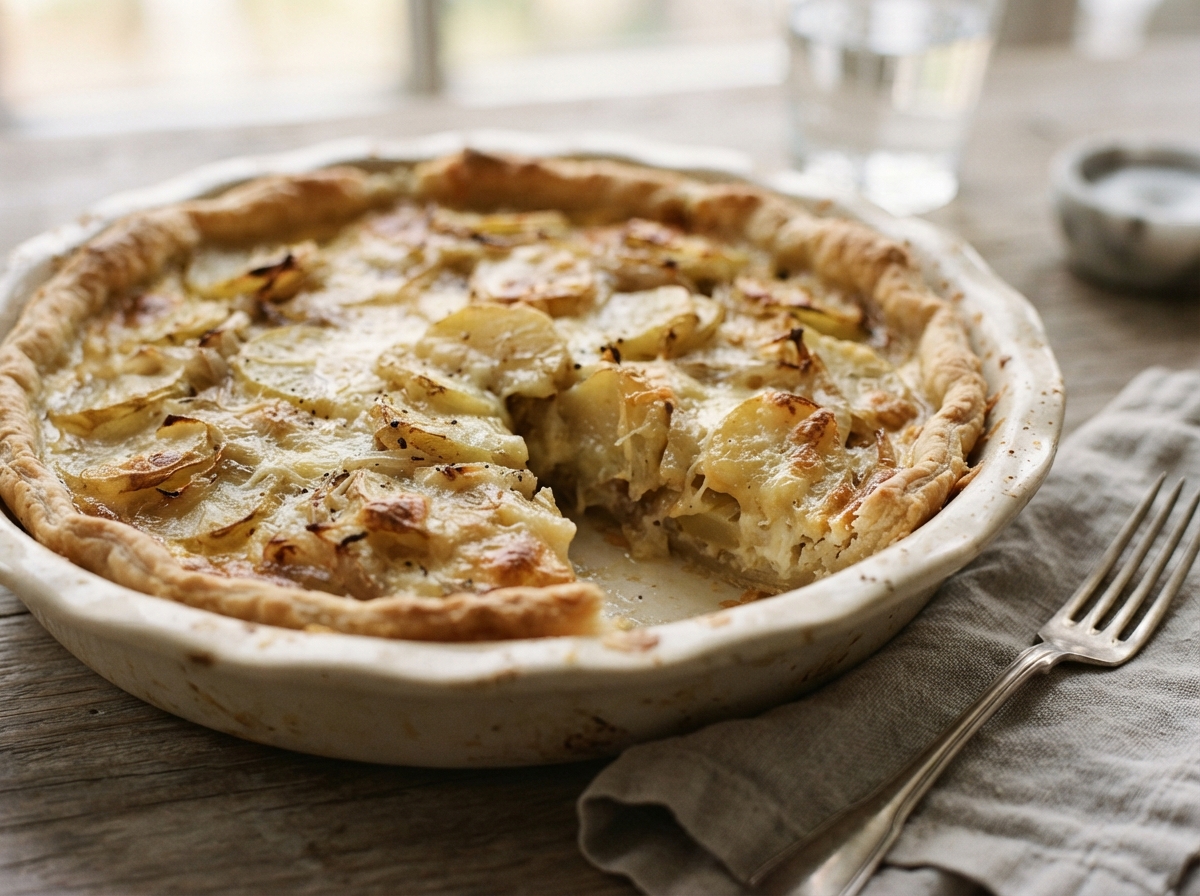
Tarte à la tomme et pommes de terre
★
★
★
★
★
Pas encore noté
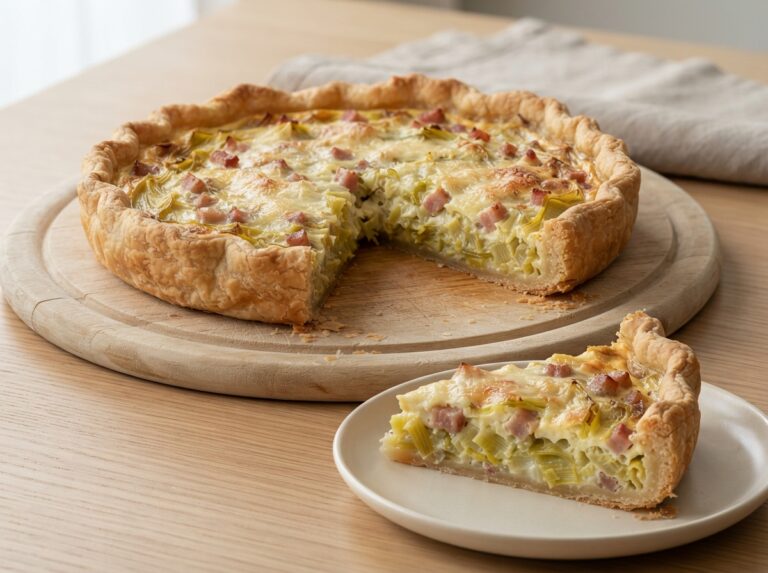
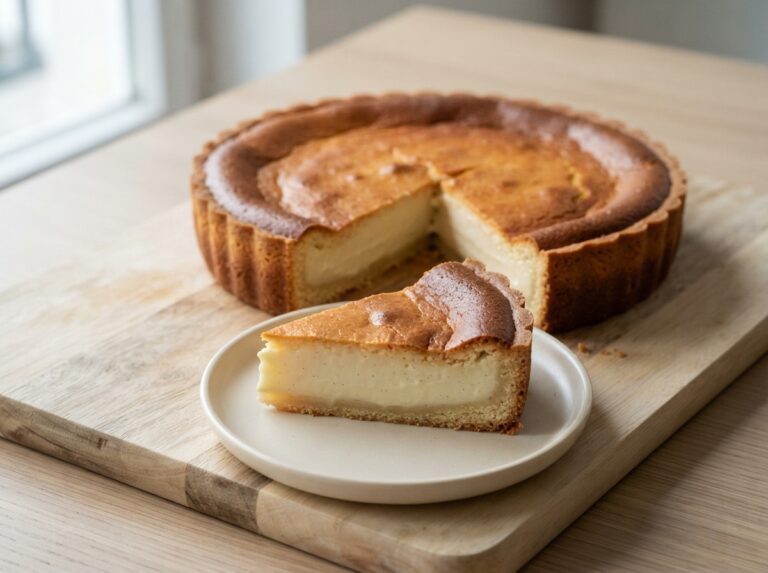
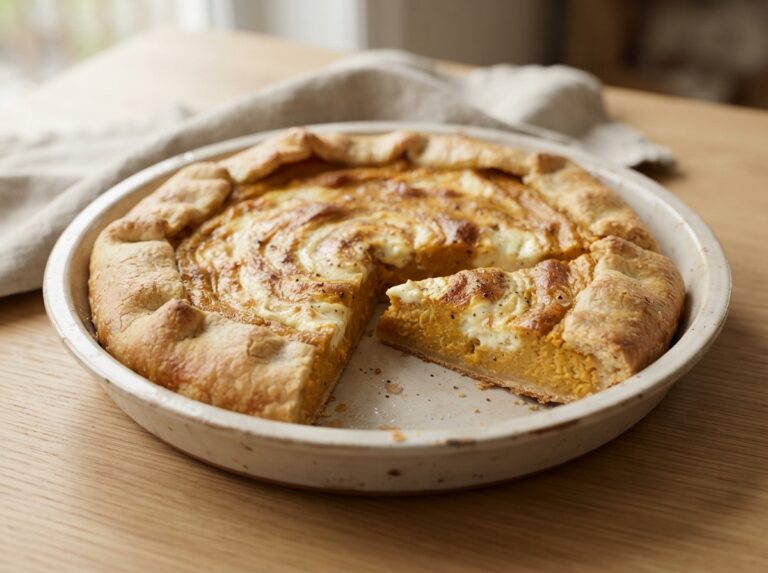
Cette tarte à la tomme plaît pour sa garniture fondante et son goût franc. Les pommes de terre apportent du moelleux, sans alourdir la part…
Ingrédients
- 1 pâte brisée
- 600 g de pommes de terre
- 250 g de tomme
- 20 cl de crème fraîche épaisse
- 2 œufs
- 1 oignon
- 1 gousse d'ail
- 1 c. à soupe de beurre
- 1 pincée de sel
- 1 pincée de poivre noir
- 1 c. à café de noix de muscade
Préparation
- Préchauffez le four à 180 °C. Étalez la pâte brisée dans un moule à tarte et piquez le fond.
- Faites cuire les pommes de terre à l'eau jusqu'à ce qu'elles soient juste tendres. Égouttez-les puis coupez-les en rondelles.
- Émincez l'oignon et hachez la gousse d'ail. Faites-les revenir dans le beurre jusqu'à légère coloration.
- Battez les œufs avec la crème fraîche. Ajoutez le sel, le poivre noir et la noix de muscade.
- Répartissez les pommes de terre sur le fond de tarte. Ajoutez l'oignon et l'ail revenus, puis la tomme en morceaux.
- Versez l'appareil à la crème sur l'ensemble, en le répartissant bien entre les ingrédients.
- Enfournez pendant 35 à 40 minutes, jusqu'à ce que la tarte soit dorée et prise au centre.
- Laissez tiédir quelques minutes avant de servir.
- part1_html placeholder
- <h2>Pourquoi la tarte à la tomme fonctionne si bien</h2><p>La tarte à la tomme séduit par son équilibre simple et très franc. La pomme de terre apporte du fondant. La tomme donne du caractère et une vraie profondeur de goût.</p><p>Cette <strong>tarte à la tomme et pommes de terre</strong> fonctionne aussi parce qu’elle reste rassasiante sans être lourde. La crème lie la garniture. Le résultat tient bien à la découpe et garde une texture moelleuse.</p><p>C’est une recette idéale pour un dîner de semaine. Elle marche aussi très bien le dimanche, avec une salade verte. Servie tiède, elle est encore plus agréable.</p><p>Le secret, ici, n’est pas la complexité. Il faut surtout bien doser l’humidité. Une garniture trop humide détrempe la pâte. Une garniture trop sèche manque de gourmandise.</p><h2>Ce qui rend cette recette vraiment réussie</h2><p>La première clé, c’est la cuisson des pommes de terre. Elles doivent être tendres, mais pas farineuses. Sinon, elles se cassent à la coupe et perdent leur tenue.</p><p>La deuxième clé, c’est la tomme. Elle doit fondre sans rendre le dessus gras. Coupez-la en morceaux réguliers pour qu’elle se répartisse bien dans toute la tarte.</p><p>Enfin, l’appareil crème-œufs doit rester simple. Il ne doit pas noyer la garniture. Il doit juste envelopper les pommes de terre et l’oignon avec souplesse.</p><h2>Quels ingrédients pour réussir la tarte à la tomme</h2><h3>La pâte brisée, pour la base</h3><p>La pâte brisée forme le socle de la tarte. Une pâte de bonne qualité supporte bien les pommes de terre et la crème. Elle doit rester friable et nette après cuisson.</p><p>Avec 1 pâte brisée, vous gagnez du temps sans perdre en goût. Piquez bien le fond pour éviter qu’elle gonfle. Un léger repos au frais améliore aussi la tenue.</p><h3>Les pommes de terre, pour le fondant</h3><p>Les 600 g de pommes de terre apportent la matière et le moelleux. Choisissez-les à chair ferme pour garder de belles rondelles. Elles doivent cuire sans se transformer en purée.</p><p>Coupez-les en tranches régulières pour une cuisson homogène. Si elles sont très épaisses, la tarte sera moins fondante. Si besoin, précuisez-les juste assez pour qu’elles restent entières.</p><h3>La tomme, pour le goût</h3><p>Les 250 g de tomme donnent le goût signature de la recette. Prenez une tomme souple, mais pas trop sèche. Elle doit fondre correctement et parfumer toute la tarte.</p><p>Coupez-la en morceaux ou en lamelles selon votre préférence. Répartissez-la entre les pommes de terre pour éviter une concentration au centre. Vous obtiendrez ainsi des parts plus équilibrées.</p><h3>La crème fraîche, pour l’onctuosité</h3><p>Les 20 cl de crème fraîche épaisse lient la garniture. Elle apporte une texture souple et douce. C’est elle qui donne le côté fondant à la coupe.</p><p>Ne la remplacez pas par une crème trop fluide si vous voulez une tarte bien tenue. Mélangez-la aux œufs juste avant le montage. Cela évite une garniture séparée à la cuisson.</p><h3>Les œufs, pour la tenue</h3><p>Les 2 œufs structurent l’appareil. Ils aident la tarte à se figer proprement. Sans eux, la garniture serait plus fragile à la découpe.</p><p>Battez-les seulement jusqu’à homogénéité. Inutile de les fouetter trop longtemps. Une texture lisse suffit pour bien répartir la crème et les assaisonnements.</p><h3>L’oignon, pour la douceur</h3><p>1 oignon apporte une note douce et légèrement sucrée. Une fois revenu, il se marie très bien avec la tomme. Il évite une garniture trop monotone.</p><p>Coupez-le finement pour qu’il fonde dans la tarte. Faites-le revenir doucement, sans le brûler. Il doit devenir translucide avant d’être ajouté.</p><h3>La gousse d’ail, pour relever</h3><p>1 gousse d’ail suffit pour relever l’ensemble. Elle doit rester discrète et ne pas dominer la tomme. L’ail donne surtout du relief en arrière-goût.</p><p>Hachez-la finement pour une diffusion régulière. Ajoutez-la en fin de cuisson de l’oignon pour éviter l’amertume. Un excès d’ail couvrirait la finesse du fromage.</p><h3>Le beurre, pour faire revenir</h3><p>1 c. à soupe de beurre sert à cuire l’oignon et l’ail. Il apporte une note ronde et agréable. Il aide aussi à bien amorcer la coloration.</p><p>Faites-le fondre à feu moyen seulement. Un beurre trop chaud colore trop vite. Mieux vaut une cuisson douce pour garder une belle douceur aromatique.</p><h3>Le sel, pour équilibrer</h3><p>1 pincée de sel réveille la crème, la pomme de terre et le fromage. La tomme est déjà salée, donc il faut rester mesuré. Le dosage doit rester léger.</p><p>Salez l’appareil avec prudence, après avoir goûté si possible. La garniture se concentre à la cuisson. Il vaut mieux rectifier à la fin que trop saler au départ.</p><h3>Le poivre noir, pour la finition</h3><p>1 pincée de poivre noir apporte une note chaude. Il relève la douceur de la pomme de terre. Il dynamise aussi la richesse de la crème.</p><p>Moulez-le juste avant usage pour garder son parfum. Un poivre trop fin disparaît vite à la cuisson. Un tour de moulin suffit largement ici.</p><h3>La noix de muscade, pour la profondeur</h3><p>1 c. à café de noix de muscade donne un accent classique et chaleureux. Elle se marie très bien aux œufs et à la crème. Elle renforce le côté réconfortant de la tarte.</p><p>Râpez-la finement pour éviter les paquets. N’en mettez pas trop, car son arôme prend vite le dessus. Une touche discrète suffit largement.</p><h2>Peut-on remplacer certains ingrédients ?</h2><p>Oui, vous pouvez remplacer la tomme par du cantal ou du beaufort. Le goût sera plus marqué, parfois plus fruité. La texture fondra aussi un peu différemment.</p><p>Les pommes de terre peuvent être complétées par quelques rondelles de poireau. La tarte sera plus douce et plus végétale. En revanche, elle perdra un peu de son côté rustique.</p><h2>Quel matériel prévoir avant de commencer ?</h2><p>Prévoyez un moule à tarte, une casserole et une poêle. Il faut aussi un saladier pour l’appareil. Un couteau bien aiguisé facilitera la découpe des légumes et du fromage.</p><p>Une passoire aide à bien égoutter les pommes de terre. Une râpe peut servir pour la muscade si vous l’utilisez entière. Gardez aussi une cuillère en bois et un fouet à portée de main.</p><h2>Les petits gestes à préparer avant de lancer la cuisson</h2><p>Commencez par chauffer le four. Faites ensuite cuire les pommes de terre à l’avance. Pendant ce temps, émincez l’oignon et préparez la tomme.</p><p>Égouttez très soigneusement les pommes de terre après cuisson. Préparez aussi l’appareil à la crème juste avant le montage. Cette <strong>tarte à la tomme et pommes de terre</strong> gagne beaucoup en tenue avec une mise en place nette.</p><h2>À retenir avant de passer à la préparation</h2><p>Le point essentiel, c’est l’équilibre entre fondant et tenue. La garniture doit rester moelleuse sans détremper la pâte. La tomme doit se sentir à chaque bouchée.</p><p>Le geste le plus important reste l’égouttage des pommes de terre. Une bonne répartition de la crème fait aussi toute la différence. Avec ces deux points, la tarte devient vraiment réussie.</p><p><strong>La préparation complète et détaillée vous attend à la page suivante.</strong></p>
- image_prompt
- A realistic **tarte à la tomme et pommes de terre** fresh from the oven, golden, rustic, and gently bubbling at the edges.nnFinal dish presentation:n- photographed from a realistic 22-degree side angle above the tart, matching the round shape of the dishn- not top-down, not flat lay, not front-onn- the tart remains centered horizontally in the frame, with the full round tart dish entirely visible and all edges unobstructedn- one slice removed and placed back in the tart area, partially separated to reveal the creamy interior layersn- served in a round ceramic tart dish on a light wooden tablen- a single metal fork resting in the foreground below the dish, dish stays centeredn- no dramatic props, no clutter, soft linen napkin only if barely visiblennTarte cross-section:n- the cut section reveals a tender filling made of overlapping potato slices and melted tomme, with 2 to 3 clearly visible stratan- the potatoes appear as soft, pale ivory slices that hold their shape and stack neatlyn- the cheese forms a creamy, melted layer between the potato slices and the custard-like bindingn- the top surface is lightly browned with a few deeper golden patches, but not heavily burntn- the interior must look moist and structured, never watery, never mashed, never collapsednnSTRICT INGREDIENT CONSISTENCY:n- the pastry crust must appear as a golden, firm outer base and edge, never puffed like puff pastryn- the potatoes must appear as thin, tender, overlapping slices, never diced or mashedn- the tomme must appear melted and stretchy inside, with soft creamy pockets, never as dry cubesn- the cream and eggs must appear as a smooth, set custard binding the filling, never separate or curdledn- the onion must appear as soft translucent slivers, gently folded into the filling, never raw-lookingn- the garlic must be invisible as individual pieces, fully integrated into the fillingn- the butter must be expressed only through a rich glossy cooked sheen, not as visible yellow lumpsn- the salt, black pepper, and nutmeg must be suggested through seasoning and subtle flecks only, never as visible pilesn- never substitute ingredients, no ingredients outside the recipennSTRICT QUANTITY CONSISTENCY:n- the potatoes are the hero ingredient and must occupy approximately 55% of the visible fillingn- the tomme must be clearly present throughout the tart, but not overwhelm the potatoes visuallyn- the custard layer should remain thinner than the potato layer, acting as a binder rather than the main bulkn- never reduce ingredient quantities for aesthetic reasonsnnPotato texture:n- pale ivory slices, tender, slightly glossy, holding their shapen- layered and slightly overlapping, with clean edges visible in the cut sectionnnTomme texture:n- pale yellow to light cream melted cheese, soft, stretchy, and glossyn- embedded in the filling and gently pooled in pockets, not stringy on the surfacennCustard texture:n- creamy pale beige, smooth, set, and lightly glossyn- delicate and cohesive, not runny, not rubberynnColor palette:n- golden-brown crust, pale ivory potatoes, creamy beige custard, soft yellow melted tomme, translucent pale onion, warm rustic tonesnnVisual realism:n- authentic homemade tart appearance, natural browned edges, realistic crumb and set interior, no duplicated slice patterns, visible structure in the cut portion, realistic thickness and depthnnFood photography:n- ultra-realistic professional food photography, soft diffuse natural window side lighting, gentle shadows, shallow depth of field, strong background blur, 85mm macro lens feel, highly detailed textures, 8K photorealistic quality, razor-sharp focus on the tartnnNo timing text, no descriptions, no overlay, no extra notes, no clutter, minimal shadows, no numbers, no digits, no watermark, no logo, no captions of any kind anywhere in the image.
- collage_prompt
- A vertical Pinterest-style food photography collage for **tarte à la tomme et pommes de terre**, portrait orientation, 2:3 aspect ratio, EXACTLY 6 square photo panels arranged in a 2-column by 3-row grid (2x3, total 6, no more no less), same bowl/pan/plate and consistent lighting across all panels. This is a plain photographic grid, not an infographic, not a tutorial graphic, not a diagram — just six ordinary food photographs placed side by side. ABSOLUTELY NO TEXT ANYWHERE: no panel numbers, no digits, no badges, no circles, no ingredient name captions or labels under any bowl or item, no watermark, no words in any language. Pure photography only, zero typography of any kind.nnStyle:n- ultra-realistic food photography, bright natural lighting, clean modern kitchen aesthetic, soft shadows and realistic textures, elegant Pinterest-style composition, premium food magazine look, soft pastel or white background, LOW EYE-LEVEL SIDE ANGLE for every panel — 10 to 25 degrees above the food, matching exactly the same camera height/angle used in the featured image above (never top-down, never flat lay, never a three-quarter overhead view; the camera stays roughly at the height of the food itself across all 6 panels for a consistent side-view aesthetic), highly appetizing and realisticnnPanneau en haut à gauche — ingredients: raw ingredients displayed in separate small bowls and on small plates, all visible with their true colors and textures. Show the shortcrust pastry dough, the peeled potatoes, the tomme, the cream, the eggs, the onion, the garlic, the butter, the salt, the black pepper, and the nutmeg, all with no labels and no text.nPanneau en haut à droite — the potatoes being boiled until just tender, then drained in a pot or colander, with visible steam and soft, pale potato slices in hot water or just after draining; this must be a real cooking step, not a cutting-only mise en place scene.nPanneau du milieu à gauche — the onion and garlic gently sautéing in butter in a pan, showing translucent onion and a soft glossy sheen from the butter, with slight golden color beginning to appear.nPanneau du milieu à droite — the tart being assembled in a round ceramic tart dish: pastry base lined, overlapping potato slices arranged inside, sautéed onion and garlic added, and chunks or pieces of tomme visible among the potatoes, all clearly separated and not blended.nPanneau en bas à gauche — the fully baked tart in its round ceramic dish, centered, golden on top, lightly browned at the edges, with a neat rustic baked surface and the same dish and same wooden table as the featured image.nPanneau en bas à droite — extreme close-up macro of a single slice from the baked tart, resting stably on a small matte cream ceramic dessert plate in the foreground, slice tip pointing toward the camera to reveal the creamy interior, with the same golden crust, overlapping potato slices, and melted tomme visible in the cross-section. The slice must be perfectly centered in the frame, very close, with the plate only partially visible, and a bright natural daylight look.nnFood details: ingredients must look fresh and realistic; potatoes should be pale, tender, and intact; the tomme should look soft and melted; the custard should appear smooth and glossy; the crust should be golden and firm; realistic steam and light browning are welcome where appropriate.nQuality: ultra-detailed, professional culinary photography, Pinterest-viral aesthetic, 4K realistic rendering, consistent lighting and color across all 6 panels, clean composition, no clutter.nThe final collage must feel like an authentic step-by-step Pinterest recipe guide for this exact dish, not a generic tart recipe.nSTRICT REQUIREMENTS: portrait orientation, 2:3 aspect ratio, exactly 6 panels total, arranged in a 2x3 grid, absolutely no more and no less. ABSOLUTELY NO TEXT ANYWHERE IN THE IMAGE, of any kind: no panel numbers, no digits, no step counters, no numbered badges or circles, no ingredient names written as captions or labels under bowls/items, no watermark, no logo, no captions, no words in any language, no typography of any kind. This is a pure photograph — if you find yourself about to render any letter, word, or number anywhere in the frame, do not. Pure photography only, zero graphic overlays, zero text.
Notez cette recette
★★★★★