Préparation :
- Faites dessaler les ris de veau dans de l’eau froide pendant trente minutes. Égouttez-les ensuite soigneusement, puis retirez les petites membranes et les dernières impuretés visibles. Séchez-les très bien avec du papier absorbant, car une surface humide empêcherait la belle coloration en poêle.
- Nettoyez rapidement les morilles fraîches sous un filet d’eau froide. Coupez-les en deux si elles sont grosses, puis réservez-les bien égouttées. Hachez finement l’échalote et la gousse d’ail, puis ciselez le persil plat.
- Faites chauffer l’huile neutre avec la moitié du beurre dans une grande poêle. Saisissez les ris de veau à feu moyen-vif jusqu’à obtenir une belle croûte dorée sur chaque face. La surface doit devenir bien nacrée et légèrement croustillante, tandis que l’intérieur reste moelleux.
- Retirez les ris de veau, puis ajoutez le reste de beurre dans la même poêle. Faites revenir l’échalote hachée avec l’ail haché, juste le temps qu’ils deviennent translucides. Ajoutez les morilles et laissez-les rendre leur eau, puis laissez cette humidité s’évaporer complètement avant d’ajouter le vin jaune.
- Versez le vin jaune et laissez réduire quelques minutes. Ajoutez la crème fraîche épaisse, puis remettez les ris de veau dans la sauce pour les napper. Laissez chauffer doucement jusqu’à obtenir une sauce liée, brillante et parfumée. Rectifiez avec le sel, le poivre et le jus de citron.
- Servez aussitôt les ris de veau bien chauds, nappés de morilles et de sauce au vin jaune. Parsemez de persil plat ciselé au dernier moment pour garder une note fraîche.
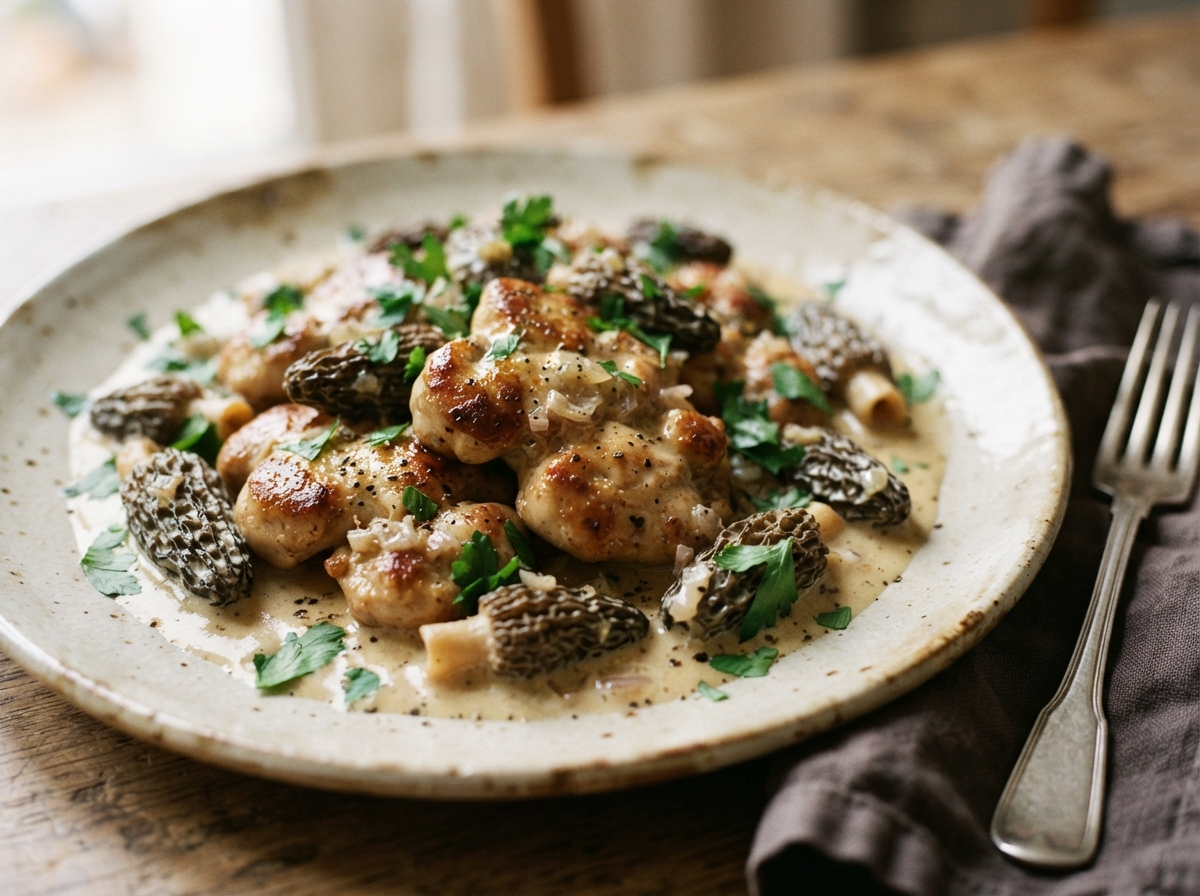
- En cuisine, les plats les plus mémorables sont souvent les plus précis. Les ris de veau poêlés aux morilles et au vin jaune en font partie. Ce plat français réunit une chair délicate, une sauce noble et des arômes très nets. L’ensemble donne une assiette élégante, profonde et très gourmande.Ce que j’aime ici, c’est l’équilibre entre finesse et générosité. La recette de ris de veau aux morilles reste accessible si l’on respecte quelques gestes simples. Le tout se prépare en moins de 90 minutes, avec une vraie sensation de cuisine soignée. La poêle fait le plus gros du travail.Le contraste est particulièrement réussi. Les ris de veau deviennent croustillants dehors et fondants dedans. Les morilles apportent une texture souple, presque charnue, tandis que le vin jaune donne une longueur très aromatique. La sauce crémeuse enveloppe chaque bouchée sans alourdir l’ensemble.Vous pouvez personnaliser la recette avec un peu de cerfeuil ou de ciboulette. Une pointe de moutarde douce fonctionne aussi très bien dans la sauce. Si vous aimez les plats plus vifs, gardez un trait de citron en fin de cuisson. Cette base convient parfaitement à une cuisine rapide, mais exigeante sur la qualité.Ce plat plaît aux adultes comme aux invités amateurs de cuisine française. Il fonctionne très bien pour un dîner de saison ou un repas de fête. Servez-le avec des tagliatelles fraîches, un riz pilaf ou une purée maison. Une salade verte croquante apporte aussi un bel équilibre.
- image_prompt
- **Ris de veau poêlés aux morilles et au vin jaune** served as a finished, plated French restaurant dish.Final dish presentation:
– photographed from a 30-to-35-degree camera angle above the dish (sweet spot 35°), camera positioned slightly above the rim of the vessel and looking slightly downward. The FOOD SURFACE (garnish, sauce, pieces inside) faces the viewer as the main subject and occupies at least 55-65% of the vessel’s visible height. The top rim forms a moderately flattened ellipse with a height-to-width ratio between 1/2.5 and 1/3.5 — NEITHER a very thin ellipse (which would be a near-side 15-25° view, forbidden) NOR a near-round circle (which would be a near-top-down 50-plus-degree view, forbidden). The outer side wall of the vessel is visible but takes no more than 30-40% of the vessel’s visible height — a frame around the food surface, not the main subject. Food content shows real depth with front pieces partially hiding back pieces. A soft blurred kitchen background is visible behind the dish
– served in an opaque matte cream ceramic serving plate with solid, fully opaque walls — the contents are visible only from the top opening, never through the sides of the bowl
– the whole dish is centered in the frame, filling nearly the entire image with only a narrow margin around it
– no cutlery visible, no fork, no knife, no spoon anywhere in the frame — the dish is meant to be eaten with a fork, but the scene stays clean and minimal
– no extra props, no napkin dominating the scene, no clutter, no watermark, no text
– the plate rim is clean and the composition is tight, high-impact, and magazine-styleRis de veau aux morilles and vin jaune layers:
– a generous base of glossy creamy sauce pooling at the bottom of the plate, pale golden-beige and velvety, occupying about 20% of the visible depth
– several thick pieces of poached and pan-seared sweetbreads arranged on top of the sauce, ivory-beige with golden-brown seared faces, occupying about 55% of the visible depth
– whole and halved morilles distributed between and around the sweetbreads, dark brown to deep umber, visibly wrinkled and tubular, occupying about 15% of the visible depth
– a final light coat of sauce clinging to the top surfaces and lightly glazing the sweetbreads, occupying about 10% of the visible depthSTRICT INGREDIENT CONSISTENCY:
– the ris de veau must appear as thick, irregular yet elegant sweetbread pieces, not as generic meat cubes
– the morilles must appear as real honeycombed mushrooms, not as smooth brown slices
– the sauce must appear creamy, glossy, and lightly beige from the vin jaune, never opaque white
– the parsley must appear as a very small amount of finely chopped green flecks, added only at the end
– the shallot and garlic are cooked into the sauce and should not appear as raw visible chunks
– never substitute ingredients, no ingredients outside the recipeSTRICT QUANTITY CONSISTENCY:
– quantity must clearly correspond to 800 g of ris de veau, making it the hero ingredient and the dominant visible component
– quantity must clearly correspond to 250 g of morilles, visible but secondary to the sweetbreads
– the sauce must not overwhelm the plate; it should coat and pool naturally around the main pieces
– never reduce ingredient quantities for aesthetic reasonsRis de veau texture:
– pale ivory-beige flesh with a delicate, slightly pearly interior
– golden-brown seared edges, lightly crisp in spots, with a moist tender center
– thick, soft, and luxurious-looking, with real depth and irregular natural contoursMorilles texture:
– dark brown wrinkled caps and hollow stems, highly textured and realistic
– lightly glossy from the sauce, with visible folds and ridges
– distinct and separate, never mashed or flattenedSauce texture:
– smooth, velvety, glossy cream sauce
– pale beige with warm golden reflections from the wine reduction
– lightly pooled and clinging to the sweetbreads with soft sheenParsley texture:
– tiny fresh green flecks, finely chopped
– scattered sparingly on top, bright and delicate
– not dominant, only a final fresh accentColor palette:
– ivory-beige sweetbreads, golden-brown seared surfaces, deep brown morilles, pale beige vin jaune cream sauce, bright green parsley accentsVisual realism:
– authentic homemade yet refined French plating, natural sauce distribution, realistic browning, no duplicated ingredient patterns, visible separation between sweetbreads and morilles, realistic volume and depthFood photography:
– ultra-realistic professional food photography, soft diffuse natural window/side-lighting highlighting glossy and wet textures with gentle shadows for volume, shallow depth of field, strong background blur, 85mm macro lens feel, highly detailed textures, 8K photorealistic quality, razor-sharp focus on the food, culinary magazine styleNo timing text, no descriptions overlay, no extra notes, no clutter, minimal shadows, no numbers, no digits, no watermark, no logo, no captions of any kind anywhere in the image.
- collage_prompt
- A vertical Pinterest-style food photography collage for **Ris de veau poêlés aux morilles et au vin jaune**, portrait orientation, 2:3 aspect ratio, EXACTLY 6 square photo panels arranged in a 2-column by 3-row grid (2×3, total 6, no more no less), same serving plate and consistent lighting across all panels. This is a plain photographic grid, not an infographic, not a tutorial graphic, not a diagram — just six ordinary food photographs placed side by side. ABSOLUTELY NO TEXT ANYWHERE: no panel numbers, no digits, no badges, no circles, no ingredient name captions or labels under any bowl or item, no watermark, no words in any language. Pure photography only, zero typography of any kind.Style:
– ultra-realistic food photography, bright natural lighting, clean modern kitchen aesthetic, soft shadows and realistic textures, elegant Pinterest-style composition, premium food magazine look, soft neutral background, FIXED 35-DEGREE CAMERA ANGLE above the food for EVERY one of the 6 panels (identical camera elevation across all 6 panels AND matching the same 35° angle used in the featured image above — never top-down, never flat lay, never a three-quarter overhead view, never a low 10-15° near-eye-level view, exactly 35 degrees above the food for consistent framing), highly appetizing and realisticPanneau en haut à gauche — ingredients:
– small separate bowls and plates showing the real ingredients from the recipe: pale ivory raw sweetbreads, dark wrinkled morilles, a small glass of golden vin jaune, a bowl of thick cream, a small pat of butter, one shallot, one garlic clove, fresh parsley, a small pinch of salt, black pepper, and lemon juice in a tiny dish
– keep each ingredient clearly separated in its own little container
– no labels, no written names, no hands, no utensils used for actionPanneau en haut à droite — preparation step:
– the sweetbreads being gently dried and trimmed on a clean prep surface is not allowed here, because the collage must show cooking action, not just raw mise en place
– show the sweetbreads already in a hot pan, just after the first proper sear has begun, with a visible golden crust forming on the surface
– the pan must be the main visible cooking vessel, and the sweetbreads must look pale ivory-beige with emerging golden-brown seared faces, not raw and not fully finished
– the scene should clearly feel like active cooking heat, with realistic gloss and light steamPanneau du milieu à gauche — next cooking stage:
– the shallot and garlic have been added to the same pan after the sweetbreads were removed
– show them as very finely minced specks softened in butter, almost melting into the pan juices, with the morilles added and releasing moisture
– the morilles should appear dark, wrinkled, and glossy, with visible texture, while the aromatic base looks translucent and gentle
– the cooking stage must feel distinctly different from the searing panel above: this is the mushroom-and-aromatic reduction stage, not the initial browning stagePanneau du milieu à droite — sauce stage:
– show the vin jaune reduction and cream added to the pan, forming a glossy pale beige sauce around the morilles and sweetbreads
– the sauce should look smooth, velvety, and lightly thickened, with visible sheen and soft bubbling at the edges
– the sweetbreads must be returned to the sauce, partially coated and nestled among the morilles, but not yet presented as the final plated dish
– use the same type of pan or skillet as in the cooking steps, with realistic stovetop contextPanneau en bas à gauche — the finished dish:
– the complete finished dish of ris de veau poêlés aux morilles et au vin jaune, plated in the same opaque matte cream ceramic serving plate as in the featured image, not in the cooking pan
– the sweetbreads must be beautifully arranged with morilles and creamy vin jaune sauce, refined and restaurant-like, with the same ivory-beige, golden-brown, deep brown, and pale beige palette as the featured image
– the plate must sit on the same kind of clean neutral surface, with no extra props taking attention away from the food
– no cutlery visible, no side dish, no clutter, no text, no hands, no cooking vesselPanneau en bas à droite — extreme close-up final hero shot:
– a tight macro close-up of one single sweetbread piece resting stably on the same plate surface, coated with a little vin jaune cream sauce and a nearby morille for context
– this is not a different dish; it must look like a much tighter crop of the same finished plate and lighting setup
– the sweetbread should fill almost the entire panel, with only a minimal visible edge of the plate
– the texture must be ultra-detailed: golden-brown seared exterior, moist ivory interior, glossy sauce, wrinkled mushroom surface, and tiny parsley flecks
– keep the composition perfectly centered, bright, and appetizing, with a strong bokeh background and no utensils or handsFood details:
– ingredients must appear fresh and realistic; cream sauce rich and detailed; morilles wrinkled and glossy; sweetbreads thick and luxurious with proper sear; parsley tiny and vivid
– the same serving plate and same neutral surface must be reused in the final-dish panels for perfect consistency
– each panel must look like a different stage of the same recipe, not a generic French recipe collageQuality:
– ultra-detailed, professional culinary photography, clean Pinterest-viral aesthetic, photorealistic 4K quality, coherent lighting, realistic cooking and plating progression, visually distinct panel-to-panel storytellingSTRICT REQUIREMENTS: portrait orientation, 2:3 aspect ratio, exactly 6 panels total, arranged in a 2×3 grid, absolutely no more and no less. ABSOLUTELY NO TEXT ANYWHERE IN THE IMAGE, of any kind: no panel numbers, no digits, no step counters, no numbered badges or circles, no ingredient names written as captions or labels under bowls/items, no watermark, no logo, no captions, no words in any language, no typography of any kind. This is a pure photograph — if you find yourself about to render any letter, word, or number anywhere in the frame, do not. Pure photography only, zero graphic overlays, zero text.
Conseils :
- Dessalez et séchez parfaitement les ris de veau pour obtenir une belle croûte dorée en poêle.
- Nettoyez les morilles rapidement sous l’eau froide, puis égouttez-les soigneusement avant cuisson.
- Laissez évaporer toute l’eau des morilles avant d’ajouter le vin jaune, pour concentrer la saveur.
- Ajoutez la crème à feu doux seulement, afin d’éviter qu’elle ne tranche.
- Servez immédiatement avec une purée maison, des tagliatelles fraîches ou un riz pilaf pour absorber la sauce.
FAQs :
Peut-on préparer les ris de veau aux morilles à l’avance ?
Oui, vous pouvez nettoyer les morilles et préparer la base de sauce quelques heures avant. En revanche, saisissez les ris de veau au dernier moment pour garder leur texture moelleuse et dorée.
Quel accompagnement sert le mieux avec cette recette au vin jaune ?
Une purée maison, des tagliatelles fraîches ou un riz pilaf fonctionnent très bien. Ces garnitures récupèrent la sauce crémeuse sans masquer les morilles.
Peut-on remplacer le vin jaune dans cette recette ?
Oui, mais le goût sera différent. Un vin blanc sec peut dépanner, avec une petite touche de xérès sec pour rappeler la profondeur aromatique.
Cette recette de ris de veau aux morilles est-elle sans gluten ?
Oui, la recette peut être sans gluten si vous vérifiez que la crème et le vin utilisés ne contiennent aucun ajout. Servez-la avec une garniture sans gluten, comme du riz ou une purée.
Comment conserver les restes de ris de veau aux morilles ?
Gardez-les au réfrigérateur dans une boîte hermétique pendant un jour ou deux. Réchauffez doucement à feu très doux, sans faire bouillir la sauce.
Peut-on utiliser des morilles séchées à la place des morilles fraîches ?
Oui, les morilles séchées conviennent très bien. Réhydratez-les d’abord dans de l’eau tiède, puis filtrez l’eau de trempage si vous voulez l’ajouter à la sauce.